Top 10 REITs in India 2026: Earn Passive Income from Commercial Real Estate
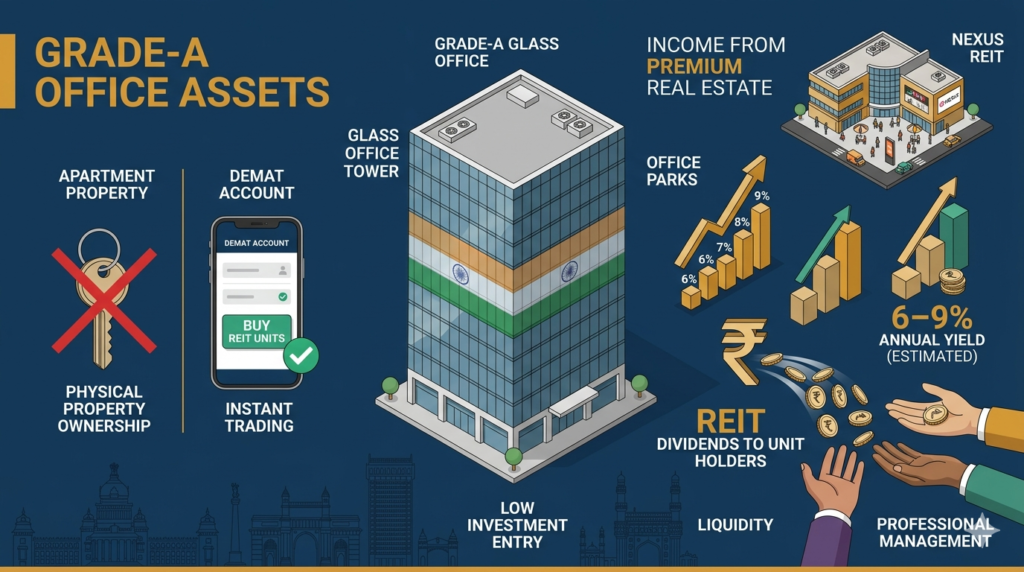
Imagine owning a piece of a 51-million-square-foot office empire in Bengaluru, Mumbai, and Pune — without purchasing a single brick. That’s exactly what REITs in India allow you to do. Real Estate Investment Trusts (REITs) let retail investors like you and me participate in the commercial real estate market by simply buying units on the stock exchange, just like you’d buy shares of Infosys or HDFC Bank.
For years, premium office parks, Grade-A business hubs, and swanky retail malls were the exclusive playground of institutional investors and ultra-HNIs. SEBI changed that in 2019 when it allowed India’s first REIT to list publicly. Fast forward to 2026, and India now has five publicly listed REITs with a combined AUM of ₹2.4 lakh crore and a growing SM REIT ecosystem that’s democratising real estate investing further than ever before.
But which REIT is right for you? How do they compare on yield, occupancy, and risk? This comprehensive guide to the top 10 REITs in India — including listed giants and emerging SM REITs — will answer every question you have.
📋 Table of Contents
What is a REIT and How Does It Work in India?
A Real Estate Investment Trust (REIT) is a company or trust that owns, operates, or finances income-producing real estate properties. In India, REITs are regulated by the Securities and Exchange Board of India (SEBI) and must comply with strict rules designed to protect investors.
Here’s how the money flows: A REIT collects rent from tenants (corporates, MNCs, retail brands) occupying its properties. It pools this rental income and is legally required to distribute at least 90% of its Net Distributable Cash Flows (NDCF) to unitholders every quarter. This makes REITs one of the most reliable sources of passive income in the Indian investment landscape.
Key Features of Indian REITs
- Listed on NSE & BSE — Buy and sell like any stock via your Demat account
- No minimum lot size — You can buy even a single unit (SEBI removed the old ₹50,000 minimum)
- Mandatory 90% distribution — Quarterly dividends from rental income
- At least 80% in income-generating properties — Mostly completed, leased assets
- SEBI regulated — Strong governance, annual disclosures, independent trustee
Why Invest in REITs in India in 2026?
India’s commercial real estate market is booming. Grade-A office occupancy rates across major cities are holding steady at around 88–93%, driven by strong demand from IT companies, global capability centres (GCCs), and BFSI tenants. Here are the strongest reasons to look at REITs in 2026:
- Higher yield than FDs: Average REIT yields of 6–8% beat most fixed deposit rates offered by top banks today
- Liquidity: Unlike physical real estate, REIT units can be sold on NSE/BSE any trading day
- Quarterly income: Distributions every three months, providing predictable cash flow
- Inflation hedge: Commercial leases include annual escalation clauses (typically 5% per year), protecting income against inflation
- Tax efficiency: A significant portion of REIT distributions is tax-free in investors’ hands when SPVs pay corporate tax
- Diversification: Exposure to real estate without the risks of direct property ownership
- Growing market: India’s REIT market cap has grown from ~₹26,400 crore in FY20 to nearly ₹2 lakh crore by FY26
Top 10 REITs in India: Detailed Analysis
India currently has 5 exchange-listed REITs and a fast-growing ecosystem of SEBI-registered SM REITs (Small & Medium REITs). We cover all of them here — from the blue-chip giants to the exciting new entrants.
India’s first and Asia’s largest publicly listed REIT, Embassy REIT is the gold standard of commercial real estate investing in India. Its portfolio spans Bengaluru, Mumbai, Pune, NCR, and Chennai — housing some of the world’s biggest tech and BFSI companies.
- Largest office REIT in Asia by area, offering unmatched scale and diversification
- Blue-chip tenant base; technology sector accounts for approximately 30% of gross annualised rentals
- Trading at ~9% discount to NAV as of recent data, offering potential upside
- Has consistently paid quarterly distributions since listing in 2019
- Strong institutional backing from Blackstone, one of the world’s largest real estate investors
Mindspace REIT owns a premium portfolio of Grade-A business parks and high-tech data centres across Mumbai, Hyderabad, Pune, and Chennai. Its presence in Hyderabad — one of India’s fastest-growing IT corridors — gives it a differentiated geographic advantage.
- Strong presence in Hyderabad, which has seen explosive GCC-driven demand
- Portfolio includes data centre assets, adding a high-growth element beyond traditional offices
- Trading at approximately 3% discount to NAV — closer to fair value than Embassy
- High-quality multinational tenant base with long-duration leases
- Backed by Blackstone’s global real estate expertise and capital
Brookfield India REIT is the country’s only 100% institutionally managed office REIT, backed by Brookfield Asset Management — one of the world’s largest alternative asset managers. Its properties span Mumbai, Gurugram, Noida, Kolkata, and Pune.
- The only REIT with 100% institutional management — no promoter family involvement
- Committed occupancy improved significantly from 82% to 92% by end of 2025
- Strong leasing momentum with 1.2 mn sq ft of gross leasing in Q3 FY2026 alone
- Trading at approximately 5% discount to NAV, offering a margin of safety
- Smaller market cap means higher potential for unit price appreciation as occupancy grows
Nexus Select Trust holds the distinction of being India’s first and only pure retail REIT, owning 19 premium shopping malls across 15 cities. With an industry-leading occupancy of 97.2% and over 130 million annual visitors, it represents India’s organised retail real estate at its best.
- India’s only listed retail REIT — unique diversification from the office-heavy REIT market
- Exceptional 97.2% occupancy rate — among the highest in global retail REITs
- Recorded ₹124 billion in tenant sales in FY25, reflecting robust retail demand
- Exposure to India’s fast-growing consumption story and urban retail spending
- Backed by Blackstone’s deep retail real estate expertise from its global portfolio
The newest entrant in India’s REIT market, Knowledge Realty Trust, is a joint venture between the Sattva Group and Blackstone. It focuses on modern office campuses and commercial spaces in high-demand corporate corridors, particularly in Bengaluru and Chennai.
- India’s fifth and newest listed REIT — brings fresh Grade-A office supply to the market
- Projected distribution yield of ~7.22% in FY27, comparing favourably to peers
- Sattva Group’s strong development expertise combined with Blackstone’s asset management capabilities
- Post-tax yield projected to exceed major bank FD rates, making it attractive for income seekers
- Entry into growing corporate demand zones, especially driven by GCC expansions
SM REITs: The New Frontier (Ranks 6–10)
SEBI introduced the SM REIT framework in March 2024 to regulate fractional real estate platforms and provide retail investors access to smaller income-generating assets valued between ₹50 crore and ₹500 crore. The minimum investment is ₹10 lakh. Unlike listed REITs, SM REITs launch individual schemes (like IPOs) for specific properties.
PropShare Platina made history as India’s very first SM REIT scheme, launched by Property Share Investment Trust in December 2024. The scheme is backed by a LEED Gold certified office building on Bengaluru’s Outer Ring Road (Prestige Tech Platina), leased to a major US-based tech company on a fresh 9-year lease.
- Pioneer SM REIT — first mover in a transformative new asset class
- 9-year lease with a US tech company; 4.6-year weighted average lock-in provides stability
- Projected distribution yield of 9% for FY26 — significantly higher than listed REITs
- Investment manager has waived all management fees for FY25 and FY26 — investor-friendly structure
- Listed on BSE; minimum investment of ₹10 lakh per unit
The second scheme under Property Share Investment Trust, PropShare Titania followed the success of Platina with an even larger IPO of ₹473 crore in July 2025. Property Share has quickly established itself as the market leader in India’s SM REIT ecosystem.
- Second scheme from India’s most active SM REIT manager — demonstrating scalable execution
- Larger ₹473 crore raising versus Platina’s ₹353 crore, reflecting growing investor appetite
- Adds diversification for investors already holding PropShare Platina
- SEBI-regulated with full offer document disclosure
PropShare Celestia is the third and newest scheme under Property Share Investment Trust, with its IPO opening on April 10, 2026. This gives investors an active and timely opportunity to participate in India’s expanding SM REIT market right now.
- Live opportunity — IPO open April 10–16, 2026 for interested investors
- Part of the established PropShare family with a growing track record
- Price band of ₹10 lakh to ₹10.5 lakh per unit; minimum investment ₹10 lakh
- SEBI-registered with full regulatory oversight and disclosure requirements
hBits is one of India’s second SEBI-approved SM REIT managers. A Mumbai-based fractional ownership platform with over 100,000 registered users, hBits is migrating its portfolio of 16 prime commercial assets into the SM REIT structure and targeting ₹2,000 crore in AUM.
- SEBI approved SM REIT manager with a large existing user base and asset portfolio
- Focuses on Grade-A commercial properties in India’s top 10 cities
- Projected rental yields up to 10% with IRR potential up to 18% according to the company
- Backed by Capricon Realty (Thackersey Group) with ₹40 crore Series A funding
- Backed by Shiv Parekh’s vision to democratise Grade-A commercial real estate for retail investors
ImpactR SM REIT, launched by Rudrabhishek Enterprises Limited, was among the earliest recipients of SEBI’s SM REIT licence. It is positioning itself as an alternative option in the growing SM REIT landscape, targeting real estate assets in commercial and mixed-use segments.
- Among the first SEBI-approved SM REIT managers in India — regulatory pioneer
- Rudrabhishek Enterprises brings urban planning and real estate advisory expertise
- Provides geographic and sectoral diversification potential from PropShare’s Bangalore-focused portfolio
- Adds a competitive alternative in the SM REIT space, which benefits all investors through price discovery
Quick Comparison: Top Listed REITs in India 2026
| REIT | Type | Listed | Portfolio Size | Approx. Yield | Occupancy | Key Cities |
|---|---|---|---|---|---|---|
| Embassy REIT | Office | 2019 | 51.1 mn sq ft | ~6% | ~92% | BLR, MUM, PUN, NCR |
| Mindspace REIT | Office | 2020 | ~34 mn sq ft | ~5.5% | ~88–90% | HYD, MUM, PUN, CHN |
| Brookfield REIT | Office | 2021 | 10 assets | ~6% | ~92% | MUM, GGN, NOI, KOL |
| Nexus Select Trust | Retail | 2023 | 10.6 mn sq ft | ~6% | 97.2% | Pan-India (15 cities) |
| Knowledge Realty Trust | Office | 2025 | New entrant | ~7.22% (FY27E) | Growing | BLR, CHN |
| PropShare Platina | SM REIT | Dec 2024 | 246,935 sq ft | ~9% (FY26E) | 100%* | Bengaluru |
*Single asset fully leased. Data as of Q1 2026 from publicly available sources. Past performance and projections are not guarantees of future returns.
📚 Related Articles on InvestIndia.blog
💡 Expert Tips for Investing in REITs
A high yield is great, but sustainable yield matters more. Analyse occupancy trends, tenant quality, and Weighted Average Lease Expiry (WALE) before investing.
REITs with exposure to Bengaluru, Hyderabad, and Mumbai tend to see stronger leasing demand due to GCC growth and tech sector expansion.
For most retail investors, the five listed REITs offer superior liquidity versus SM REITs. Only allocate to SM REITs what you can hold for 5+ years.
REITs deliver the best results when held for 5–10 years, allowing compounding of quarterly distributions and NAV appreciation together.
REIT distributions have three components: dividend (often tax-free), interest income (taxable at slab rate), and return of capital (reduces cost of acquisition). Know your tax liability before investing.
Financial planners suggest REITs as a 10–20% allocation within an equity portfolio — enough to benefit from real estate exposure without over-concentration.
📖 Real-Life Case Study: Investing ₹5 Lakh in REITs
Priya’s REIT Portfolio — Bengaluru IT Professional
Priya, a 34-year-old software engineer in Bengaluru, had ₹5 lakh sitting in a bank FD earning 6.5% per year. She was looking for a better use of her money — something more tax-efficient, liquid, and ideally tied to real estate (which she believed in as an asset class but couldn’t afford to buy directly).
In mid-2023, she decided to split her ₹5 lakh across three listed REITs:
- ₹2 lakh in Embassy REIT — for stability and the longest track record
- ₹1.5 lakh in Nexus Select Trust (newly listed) — for retail diversification
- ₹1.5 lakh in Brookfield REIT — for growth potential at a NAV discount
Over the following 2.5 years, her experience was broadly positive. She received quarterly distributions ranging from approximately ₹5,500 to ₹7,000 per year on every ₹1 lakh invested (pre-tax), depending on which REIT. More importantly, a significant portion of these distributions was tax-free, improving her effective post-tax yield versus her FD.
Priya’s key takeaway: “I don’t need to worry about property maintenance, tenant issues, or registration fees. The distributions just hit my bank account every quarter.”
🚫 Common Mistakes to Avoid When Investing in REITs
- Chasing the highest yield blindly A REIT yielding 9% sounds better than one at 6%, but if the higher yield comes from a single-asset SM REIT with short lease tenure and one tenant, the risk is disproportionately higher. Always assess sustainability of the yield.
- Ignoring occupancy trends Occupancy is the heartbeat of a REIT. Even a 3–5% drop in occupancy can meaningfully reduce distributions. Always check the latest quarterly reports for leasing momentum and renewal data.
- Treating REIT distributions as pure dividends for tax purposes REIT distributions have multiple components — dividend, interest income, and return of capital — each taxed differently. Consult a CA to avoid surprises at tax filing time.
- Over-allocating to SM REITs SM REITs offer exciting higher yields but carry concentration risk (one property, one tenant in many cases) and lower liquidity. They should be a small portion of an investor’s overall REIT allocation.
- Comparing REITs to equity stocks on P/E ratios REITs are better evaluated on FFO (Funds from Operations), distribution yield, occupancy rate, WALE, and discount/premium to NAV — not traditional P/E multiples used for manufacturing or tech stocks.
- Ignoring interest rate sensitivity REITs are sensitive to interest rate movements. Rising rates increase borrowing costs for REITs and can make their yields less attractive versus fixed-income instruments. Factor in the interest rate environment when investing.
🏦 How to Invest in REITs in India
Investing in listed REITs is remarkably simple if you already have a Demat account:
- Open a Demat & Trading Account — with any SEBI-registered broker (Zerodha, Groww, Upstox, HDFC Securities, etc.)
- Search for the REIT — on NSE/BSE using the ticker symbol (e.g., EMBASSY, MINDSPACE, BIRET, NEXUS, KRT)
- Check current price and yield — compare distribution yield vs. current unit price
- Place a Buy Order — you can buy even a single unit (minimum lot size was removed by SEBI)
- Monitor distributions — quarterly payouts are credited directly to your bank account
For SM REITs like PropShare Platina or Celestia, you need to apply during the IPO window through your broker platform, with a minimum investment of ₹10 lakh per unit.
🔗 Useful External Resources
❓ Frequently Asked Questions (FAQs)
🏁 Conclusion: Your REIT Journey Starts Here
India’s REIT market is no longer in its infancy. With five listed REITs managing ₹2.4 lakh crore in assets, and a thriving SM REIT ecosystem opening up high-yield opportunities for HNIs, the Indian investor of 2026 has never had better access to commercial real estate income.
Here’s a quick action framework based on your profile:
- Conservative investor: Embassy REIT — maximum stability, longest track record
- Growth-oriented investor: Brookfield REIT — improving occupancy, NAV discount
- Consumption play: Nexus Select Trust — India’s only retail REIT
- Higher yield seeker (HNI): PropShare SM REITs — 9%+ projected yields, ₹10L minimum
- Geographic diversification: Mindspace REIT — Hyderabad exposure + data centres
Remember: REITs work best as a long-term income instrument. Reinvest your quarterly distributions, monitor occupancy trends annually, and treat your REIT allocation as the real estate component of your wealth portfolio — without ever stepping into a registrar’s office.

Prasad Govenkar is an experienced enterprise architect with over 24 years of industry expertise, specializing in telecom BSS solutions and large-scale technology transformations. Alongside his professional career in the technology domain, he has developed a strong passion for personal finance, investing, and wealth
Through InvestIndia.blog, Prasad shares practical, easy-to-understand insights to help individuals take control of their financial future. His approach combines analytical thinking from his engineering background with real-world investing experience, making complex financial concepts simple and actionable.