How to Pay ZERO Tax on a ₹12 Lakh Salary in 2026
Imagine earning ₹12 lakh a year — that’s ₹1 lakh a month — and still paying absolutely zero income tax in 2026. Sounds too good to be true? It isn’t. Thanks to landmark changes introduced in Union Budget 2025 and confirmed in Budget 2026, millions of Indian salaried employees can now legally pay zero tax on a ₹12 lakh salary under the New Tax Regime for FY 2025-26 (AY 2026-27).
In this comprehensive guide, we’ll break down exactly how this zero-tax benefit works, the key provisions you need to know — Section 87A rebate, standard deduction, NPS contributions — and what you need to do if your income is slightly above ₹12 lakh. Whether you’re a software engineer in Bengaluru, a government employee in Delhi, or a young professional anywhere in India, this guide is written specifically for you.
By the end of this post, you will understand:
- Why income up to ₹12 lakh is tax-free in FY 2025-26
- How salaried employees can push this limit to ₹12.75 lakh
- Smart legal strategies to bring your taxable income down even further
- The biggest mistakes taxpayers make when claiming this benefit
- A real-life case study showing the exact math
📖 Table of Contents
- What Changed in Budget 2025 That Made ₹12 Lakh Tax-Free?
- New Tax Regime Slabs for FY 2025-26 (AY 2026-27)
- How Section 87A Rebate Works — The Magic Behind Zero Tax
- Standard Deduction: Free ₹75,000 for Every Salaried Employee
- Can You Pay Zero Tax on Income Above ₹12 Lakh? Yes — Here’s How
- NPS Employer Contribution: The #1 Hack Under New Tax Regime
- What About Marginal Relief? (Incomes Between ₹12–₹12.75 Lakh)
- New vs Old Tax Regime: Which is Better for ₹12 Lakh Salary?
- Expert Tips for Zero Tax Planning in 2026
- Real-Life Case Study: Riya’s ₹12.75 Lakh Salary — Zero Tax!
- Common Mistakes to Avoid
- FAQs on Zero Tax on ₹12 Lakh Salary
- Conclusion
1. What Changed in Budget 2025 That Made ₹12 Lakh Tax-Free?
The Union Budget 2025, presented by Finance Minister Nirmala Sitharaman on February 1, 2025, brought the most significant middle-class tax relief in decades. The government made three sweeping changes:
- Basic exemption limit raised to ₹4 lakh (from ₹3 lakh) under the New Tax Regime
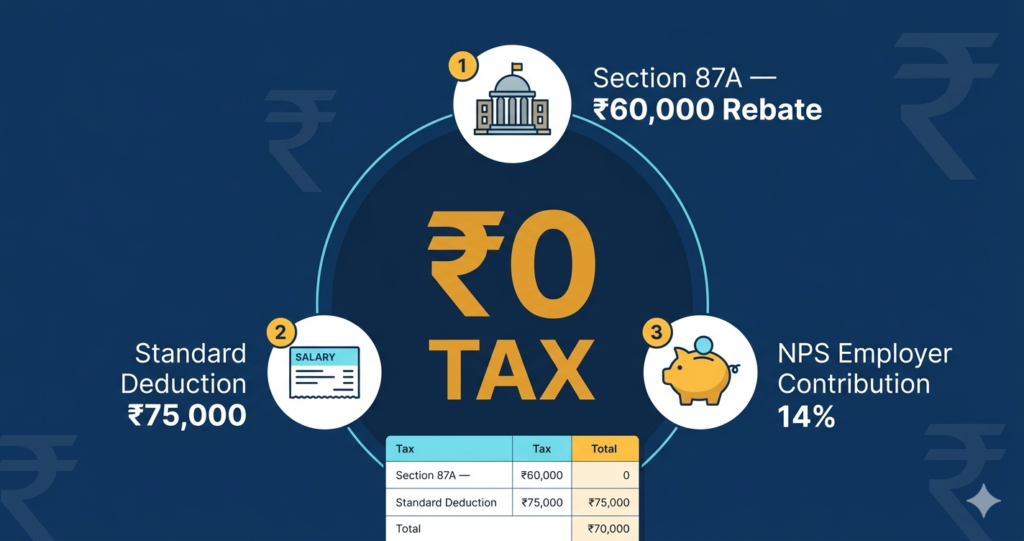
- Section 87A rebate doubled to ₹60,000 (from ₹25,000), applicable for taxable income up to ₹12 lakh
- New, wider tax slabs that are more taxpayer-friendly
- Standard deduction increased to ₹75,000 for salaried individuals
- Employer NPS deduction raised to 14% of Basic Pay (from 10%) under Section 80CCD(2)
The Finance Minister explicitly announced: “There will be no income tax payable upto income of ₹12 lakh under the new regime. This limit will be ₹12.75 lakh for salaried taxpayers, due to standard deduction of ₹75,000.” These changes apply for FY 2025-26 (Assessment Year 2026-27) and have been retained unchanged in Budget 2026 for FY 2026-27.
These changes apply specifically under the New Tax Regime (Section 115BAC), which is now the default tax regime for all taxpayers in India. You must actively opt for the Old Regime if you prefer it.
2. New Tax Regime Slabs for FY 2025-26 (AY 2026-27)
Here are the revised income tax slabs under the New Tax Regime, effective from April 1, 2025:
| Income Range | Tax Rate | Tax on Slab |
|---|---|---|
| ₹0 – ₹4,00,000 | NIL | ₹0 |
| ₹4,00,001 – ₹8,00,000 | 5% | ₹20,000 |
| ₹8,00,001 – ₹12,00,000 | 10% | ₹40,000 |
| Total Tax on ₹12 Lakh | — | ₹60,000 |
| Less: Section 87A Rebate | — | – ₹60,000 |
| Net Tax Payable | — | ₹0 |
| ₹12,00,001 – ₹16,00,000 | 15% | Up to ₹60,000 |
| ₹16,00,001 – ₹20,00,000 | 20% | Up to ₹80,000 |
| ₹20,00,001 – ₹24,00,000 | 25% | Up to ₹1,00,000 |
| Above ₹24,00,000 | 30% | 30% on excess |
Note: A 4% Health & Education Cess is applicable on the final tax liability. Surcharge applies for incomes above ₹50 lakh.
3. How Section 87A Rebate Works — The Magic Behind Zero Tax
Section 87A is the heart of the zero-tax benefit. Here’s how it works step by step:
- First, your tax liability is calculated on your taxable income using the applicable slabs.
- If your net taxable income is ₹12 lakh or below, the tax calculated comes to exactly ₹60,000.
- Section 87A provides a rebate of up to ₹60,000 — which wipes out the entire tax liability.
- Result: Zero tax payable.
The Section 87A rebate does NOT apply to special-rate income such as Short-Term Capital Gains (STCG) or Long-Term Capital Gains (LTCG) under Section 112A. If you have equity gains, those will still be taxed even if your total income is under ₹12 lakh. Plan accordingly.
4. Standard Deduction: Free ₹75,000 for Every Salaried Employee
Even under the New Tax Regime, the government allows salaried individuals a standard deduction of ₹75,000. This is a flat, automatic deduction — you don’t need to submit any proof, make any investment, or file any special form. It’s simply subtracted from your gross salary before tax is calculated.
Here’s how this changes the math for a salaried person:
| Description | Amount |
|---|---|
| Gross Salary | ₹12,75,000 |
| Less: Standard Deduction | – ₹75,000 |
| Net Taxable Income | ₹12,00,000 |
| Tax on ₹12 lakh (as per slabs) | ₹60,000 |
| Less: Section 87A Rebate | – ₹60,000 |
| Final Tax Payable | ₹0 |
This means a salaried employee with a gross salary up to ₹12,75,000 per year effectively pays zero income tax in FY 2025-26. Family pensioners also benefit from an increased standard deduction of ₹25,000.
5. Can You Pay Zero Tax on Income Above ₹12 Lakh? Yes — Here’s How
What if your salary is ₹14 lakh, ₹15 lakh, or even ₹18 lakh? Can you still pay zero — or near-zero — tax? The answer is: yes, with smart planning. The New Tax Regime allows a few specific deductions that can bring your taxable income below the ₹12 lakh threshold.
Key Deductions Available Under New Tax Regime (FY 2025-26):
- ✅ Standard Deduction — ₹75,000 flat for salaried employees
- ✅ Section 80CCD(2) — Employer’s contribution to NPS (up to 14% of basic salary)
- ✅ Section 24(b) — Interest on home loan for rented-out property (no limit)
- ✅ Gratuity Exemption — Subject to applicable threshold limits
- ✅ Leave Encashment — Exempt at the time of retirement (for govt employees: full; private: up to ₹25 lakh)
- ✅ Section 80CCH — Agniveer Corpus Fund contributions
- ✅ Family Pension Deduction — Lower of 1/3rd of pension or ₹25,000
Note: Deductions like Section 80C (PPF, ELSS, LIC), Section 80D (health insurance), HRA exemption, LTA, and home loan interest on self-occupied property are NOT available under the New Tax Regime. However, the deductions listed above can still significantly reduce your tax bill.
6. NPS Employer Contribution: The #1 Tax Hack Under the New Regime
If you earn above ₹12.75 lakh, the most powerful tool available to you under the New Tax Regime is restructuring your salary to increase your employer’s NPS contribution under Section 80CCD(2).
How It Works:
Your employer can contribute up to 14% of your Basic Salary to your NPS (National Pension System) account. This contribution is fully deductible from your taxable income under Section 80CCD(2) — in both the old and new tax regimes.
Example — Salary of ₹15 Lakh:
| Item | Amount |
|---|---|
| Gross Salary | ₹15,00,000 |
| Less: Standard Deduction | – ₹75,000 |
| Less: Employer NPS @ 14% of Basic (assume Basic = ₹7.5L) | – ₹1,05,000 |
| Net Taxable Income | ₹13,20,000 |
| Tax on ₹13.20 lakh (new slabs) | ₹78,000 |
| Less: 4% Cess | + ₹3,120 |
| Final Tax Payable | ₹81,120 |
By negotiating with your HR/payroll team to route the maximum allowable amount to NPS, you can substantially reduce your tax outgo. Talk to your employer’s HR or finance team — this is completely legal and encouraged by the government.
Request your employer to restructure your CTC (Cost to Company) so that 14% of your basic goes into NPS. This is one of the few tax-free perks that survives in the new regime. The NPS corpus grows tax-free, and 60% of the maturity amount is also tax-exempt — making it a double win.
7. What About Marginal Relief? (Incomes Between ₹12–₹12.75 Lakh)
A common fear among taxpayers is the “cliff effect”: what if your income is just ₹1,000 above ₹12 lakh — do you suddenly owe tax on the entire amount? No. The government has introduced Marginal Relief to prevent exactly this situation.
How Marginal Relief Works:
For incomes between ₹12 lakh and approximately ₹12.75 lakh, marginal relief ensures that the tax you pay never exceeds the extra income you earn above ₹12 lakh. So if your taxable income is ₹12.10 lakh (₹10,000 above the threshold), your total tax cannot be more than ₹10,000 — not the full slab tax.
Marginal relief applies only to resident individual taxpayers under the new regime. It does not apply to NRIs, HUFs, or those under the old tax regime. Also note: marginal relief only covers income up to approximately ₹12.75 lakh. Beyond that, the full slab rates apply.
8. New vs Old Tax Regime: Which is Better for ₹12 Lakh Salary?
For a ₹12 lakh income, the New Tax Regime wins hands-down. Here’s a side-by-side comparison:
| Parameter | New Tax Regime | Old Tax Regime |
|---|---|---|
| Gross Salary | ₹12,00,000 | ₹12,00,000 |
| Standard Deduction | ₹75,000 | ₹50,000 |
| 80C Deductions | Not Allowed | Up to ₹1,50,000 |
| 80D (Health Insurance) | Not Allowed | Up to ₹25,000 |
| HRA Exemption | Not Allowed | Allowed (varies) |
| Section 87A Rebate | ₹60,000 | ₹12,500 (up to ₹5L) |
| Approx. Tax (no investments) | ₹0 | ₹84,261+ |
| Winner | ✅ New Regime | ❌ (for ₹12L salary) |
The old regime may still be beneficial if you have very large deductions — typically, if your total eligible deductions (80C + 80D + HRA + home loan interest) exceed ₹3.12 lakh, you should calculate both regimes before deciding. But for most middle-class salaried employees at ₹12 lakh, the New Tax Regime is unambiguously better.
📌 Related Articles from Invest India Blog
9. Expert Tips for Zero Tax Planning in 2026
Tip 1: Maximise Your Employer NPS Contribution
As discussed, requesting your employer to route up to 14% of your basic salary into your NPS account is the single most impactful move under the New Tax Regime. Discuss this with your HR during CTC revision.
Tip 2: Optimise Your Salary Structure
Work with your HR to include components that are either exempt or tax-efficient — such as conveyance allowance for specially-abled employees, or ensuring correct classification of reimbursements (mobile, internet, etc.) that are genuinely business-use expenses.
Tip 3: Don’t Blindly Stick to the New Regime — Always Calculate Both
Use an online tax calculator like ClearTax or the Income Tax Department’s own tool to calculate your liability under both regimes before filing. If you have significant 80C investments already locked in (like EPF, home loan, or children’s tuition), the old regime might surprise you.
Tip 4: Be Careful with Capital Gains
Remember: Section 87A rebate does NOT apply to capital gains income. If you’ve made equity mutual fund gains or sold property, those are taxed separately at applicable rates (STCG at 20%, LTCG at 12.5% above ₹1.25 lakh threshold). Don’t let this catch you off guard.
The first ₹1.25 lakh of Long-Term Capital Gains (LTCG) on listed equity shares and equity mutual funds is completely tax-free every financial year. If you’re investing for the long term, ensure you book gains strategically to stay within this limit annually — this is called “LTCG harvesting” and is perfectly legal.
Tip 5: Don’t Forget to File Your ITR Even If Tax is Zero
Even if your tax liability is zero, filing your Income Tax Return (ITR) is strongly recommended. It serves as proof of income for visa applications, home loans, and other financial needs. The last date for filing ITR for FY 2025-26 is July 31, 2026 for non-business salaried individuals.
Tip 6: Check Whether Your Income is “Resident Individual”
The Section 87A rebate and zero-tax benefit applies only to resident individual taxpayers in India. NRIs (Non-Resident Indians) are NOT eligible for this rebate. If you’ve been abroad for a significant part of the year, check your residential status carefully.
10. Real-Life Case Study: Riya’s ₹12.75 Lakh Salary — Zero Tax!
Profile: Riya is a 28-year-old software engineer working at a mid-size IT company in Bengaluru. Her CTC is ₹12,75,000 per year. She opts for the New Tax Regime.
| Income & Deduction | Amount |
|---|---|
| Gross Annual Salary | ₹12,75,000 |
| Less: Standard Deduction (Section 16) | – ₹75,000 |
| Net Taxable Income | ₹12,00,000 |
| Tax on ₹0–₹4L @ 0% | ₹0 |
| Tax on ₹4L–₹8L @ 5% | ₹20,000 |
| Tax on ₹8L–₹12L @ 10% | ₹40,000 |
| Total Tax Before Rebate | ₹60,000 |
| Less: Section 87A Rebate | – ₹60,000 |
| Final Tax Payable (incl. cess) | ₹0 |
Conclusion: Riya pays absolutely zero income tax on her ₹12.75 lakh salary. Under the Old Tax Regime (with standard deduction and no other investments), she would have paid approximately ₹84,000–₹90,000 in tax. The New Tax Regime saved her the entire amount. She used the savings to increase her SIP investment from ₹5,000 to ₹12,000 per month.
Bonus Scenario: Arjun Earns ₹16 Lakh — Can He Reduce His Tax?
Profile: Arjun is 34, earns ₹16 lakh gross. His Basic Pay is ₹8 lakh. His employer contributes 14% of Basic to NPS.
| Item | Amount |
|---|---|
| Gross Salary | ₹16,00,000 |
| Less: Standard Deduction | – ₹75,000 |
| Less: Employer NPS Contribution [14% × ₹8L] | – ₹1,12,000 |
| Net Taxable Income | ₹14,13,000 |
| Tax as per New Regime Slabs | ₹93,450 |
| Add: 4% Cess | ₹3,738 |
| Final Tax Payable | ₹97,188 |
Without NPS, Arjun would have paid approximately ₹1,47,500+ in tax. By simply asking his employer to route 14% of basic to NPS, he saved over ₹50,000 in taxes — legally.
🌐 Authoritative External Sources
11. Common Mistakes to Avoid
Many taxpayers mistakenly believe that if their total income (including equity gains) is ₹12 lakh, they owe zero tax. Wrong — capital gains are taxed separately and the Section 87A rebate does not apply to them.
Your employer deducts TDS based on the regime you declare. If you don’t declare, they default to the new regime — but if you want the old regime, you must inform them explicitly at the beginning of the financial year (April).
This is the most powerful deduction available in the new regime and is widely underutilised. If your salary is above ₹12.75 lakh, not leveraging employer NPS is leaving significant tax savings on the table.
These are mutually exclusive. If you file under the new regime, 80C deductions will be rejected. Consult a CA if you’re unsure which deductions are valid for your chosen regime.
Zero tax liability does not mean you’re exempt from filing. If your income exceeds the basic exemption limit (₹4 lakh under new regime), filing ITR is mandatory. Additionally, it’s important for visa, loan, and other financial documentation.
NRIs, HUFs, and companies are not eligible for the Section 87A rebate. If you are an NRI or returned to India mid-year, consult a tax professional to determine your residential status.
12. FAQs on Zero Tax on ₹12 Lakh Salary
Conclusion: Your 2026 Action Plan for Zero Tax
The zero-tax benefit on ₹12 lakh income is one of the most generous tax reliefs India has seen in decades. If your income falls in this bracket, the message is simple: choose the New Tax Regime and pay nothing.
Here’s your quick action checklist:
- ✅ Confirm your gross salary is ₹12.75 lakh or below → Pay zero tax under New Regime
- ✅ Salary above ₹12.75 lakh? → Negotiate employer NPS contribution at 14% of Basic
- ✅ Have capital gains? → Keep LTCG under ₹1.25 lakh threshold; don’t expect 87A rebate on gains
- ✅ Calculate both old and new regime before April declaration to employer
- ✅ File your ITR by July 31, 2026 — even if tax is zero
- ✅ Redirect your tax savings into SIP, NPS, or PPF for long-term wealth creation
The government has made it easier than ever to keep more of your hard-earned money. The real question is: what will you do with the tax you saved? Start a SIP, build your emergency fund, or invest in your own skills — every rupee saved in tax is a rupee invested in your future.

Prasad Govenkar is an experienced enterprise architect with over 24 years of industry expertise, specializing in telecom BSS solutions and large-scale technology transformations. Alongside his professional career in the technology domain, he has developed a strong passion for personal finance, investing, and wealth
Through InvestIndia.blog, Prasad shares practical, easy-to-understand insights to help individuals take control of their financial future. His approach combines analytical thinking from his engineering background with real-world investing experience, making complex financial concepts simple and actionable.