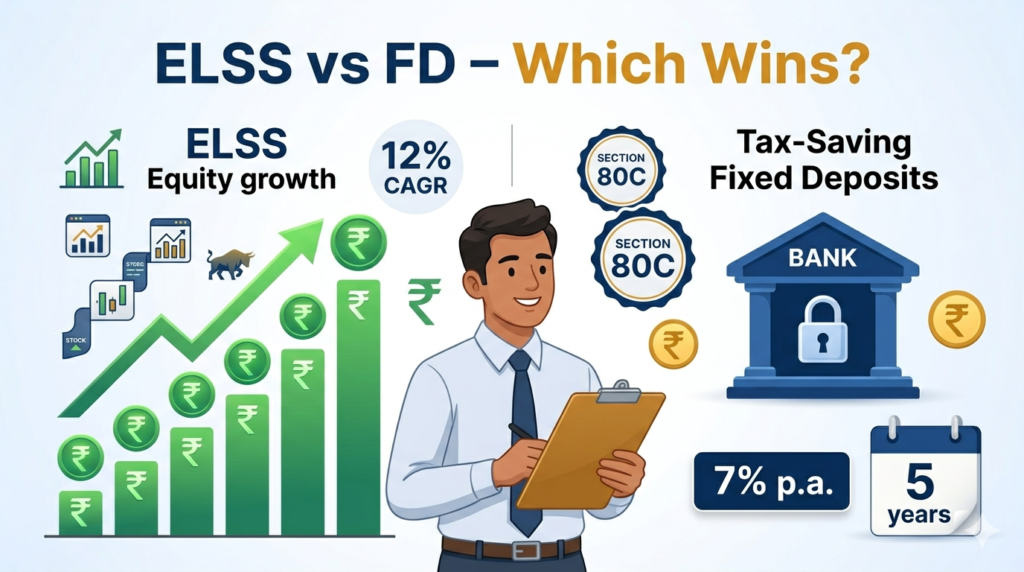
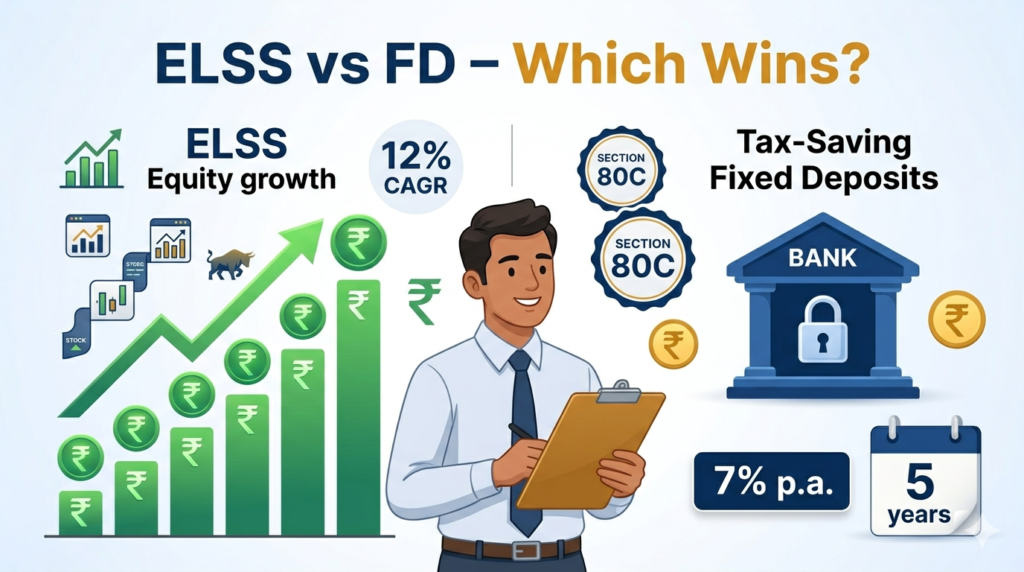
Is ELSS Better Than FD for Salaried Employees? (The Definitive 2026 Comparison)
A complete, unbiased breakdown of returns, tax savings, risk, and which option truly wins for your ₹1.5 lakh Section 80C investment.
Every March, millions of salaried employees across India scramble to make their Section 80C investments before the financial year ends. The question that comes up again and again: should I put my ₹1.5 lakh in ELSS or a Tax-Saving FD?
Both options save you the same amount of tax on paper — but what happens after that is where they diverge dramatically. One of them quietly erodes your real wealth over time. The other can multiply it. But it comes with a catch.
In this guide, you’ll get a complete, honest comparison of ELSS (Equity Linked Savings Scheme) vs Tax-Saving Fixed Deposit — covering returns, lock-in periods, taxation, risk, and exactly who should choose what. No fluff. No bias.
1. What is ELSS? A Quick Primer
ELSS — Equity Linked Savings Scheme — is a type of mutual fund that invests primarily in equity (stocks) and qualifies for tax deduction under Section 80C of the Income Tax Act. You can claim deductions of up to ₹1.5 lakh per financial year by investing in ELSS.
Unlike regular equity mutual funds, ELSS comes with a mandatory 3-year lock-in period — the shortest among all Section 80C instruments. After this period, you can redeem your units or continue holding them.
Key Features of ELSS
- Tax Deduction: Up to ₹1.5 lakh under Section 80C
- Lock-in: 3 years (mandatory, cannot be broken)
- Investment Mode: Lump sum or SIP (Systematic Investment Plan)
- Returns: Market-linked (not guaranteed), historically 10–14% CAGR over the long term
- Minimum Investment: As low as ₹500 per month via SIP
- Who Manages It: Professional fund managers at AMCs (Asset Management Companies)
ELSS is the only tax-saving investment under 80C that is directly linked to equity markets. This means higher potential returns — but also exposure to short-term market volatility. For anyone with a 5+ year horizon, this is often the smarter choice.
2. What is a Tax-Saving FD?
A Tax-Saving Fixed Deposit is a special FD offered by banks and post offices with a mandatory 5-year lock-in period. Investments made in these FDs are eligible for deduction under Section 80C, up to ₹1.5 lakh per year.
Unlike regular FDs, you cannot break a tax-saving FD prematurely, cannot take a loan against it, and cannot pledge it as collateral. The interest is fixed at the time of deposit and does not change.
Key Features of Tax-Saving FD
- Tax Deduction: Up to ₹1.5 lakh under Section 80C
- Lock-in: 5 years (strictly cannot be broken)
- Returns: Fixed interest rate — currently around 6.5% to 7.5% per annum (varies by bank)
- Risk: Capital is guaranteed (up to ₹5 lakh per bank under DICGC insurance)
- Interest Taxability: Interest earned is fully taxable as per your income tax slab
- Offered By: Public sector banks, private banks, small finance banks, post offices
Many salaried employees don’t realize that while the FD principal is deductible under 80C, the interest earned is fully taxable in the year it accrues — even if you haven’t withdrawn it. For someone in the 30% tax bracket, the effective post-tax return on a 7% FD drops to just around 4.9%.
3. ELSS vs FD: Side-by-Side Comparison
Here is a comprehensive head-to-head comparison across all key parameters:
| Parameter | ELSS (Equity Mutual Fund) | Tax-Saving FD (Bank) |
|---|---|---|
| Section 80C Benefit | ✅ Up to ₹1.5 lakh | ✅ Up to ₹1.5 lakh |
| Lock-in Period | ✅ 3 Years | ❌ 5 Years |
| Expected Returns | ✅ 10–14% CAGR (historical) | 6.5–7.5% p.a. |
| Return Type | Market-linked (variable) | ✅ Fixed & Guaranteed |
| Capital Safety | ❌ Not guaranteed | ✅ Guaranteed (up to ₹5 lakh) |
| Tax on Returns | ✅ LTCG @ 12.5% (above ₹1.25L) | ❌ Fully taxable as per slab |
| Inflation-Beating | ✅ Very likely over long term | ❌ Barely or may not |
| SIP Option | ✅ Yes (₹500/month onwards) | ❌ Not available |
| Early Withdrawal | ❌ Not allowed before 3 years | ❌ Not allowed before 5 years |
| Premature Break | ❌ Not applicable | ❌ Not permitted at all |
| Suitable For | Long-term wealth creators, risk-tolerant | Conservative, capital preservation |
4. Returns Comparison: Where Does Your Money Grow More?
This is the most important question for a salaried employee — and the answer has a striking difference when compounded over time.
Scenario: ₹1.5 Lakh Invested Annually for 10 Years
Note: ELSS returns are historical averages across diversified equity funds. Past performance does not guarantee future results. FD rates are indicative based on current major bank rates.
The Inflation Reality
India’s average CPI inflation hovers around 5–6% per year. A tax-saving FD offering 7%, after taxation in the 30% bracket, gives you only about 4.9% — which means your real return is negative after inflation. You are losing purchasing power even as your bank balance grows.
ELSS, historically delivering 10–14% CAGR over long periods, has consistently beaten inflation — giving your savings genuine, meaningful growth.
For a salaried employee in the 30% tax bracket, the post-tax real return (return minus inflation) is approximately:
Tax-Saving FD: 7% − 30% tax − 6% inflation ≈ −1.1% real return
ELSS (historical): 12% − 12.5% LTCG tax (above ₹1.25L) − 6% inflation ≈ +5.5% real return
Want to understand how mutual funds work before diving into ELSS? Read this detailed guide: 11 Types of Mutual Funds Every Indian Investor Must Know.
5. Tax Treatment: The Real Difference Nobody Talks About
Both ELSS and Tax-Saving FDs give you the same upfront tax benefit — a deduction of up to ₹1.5 lakh under Section 80C. For someone in the 30% tax bracket, that’s a direct saving of ₹45,000 (+ cess). But what happens to the returns is a completely different story.
ELSS Tax Treatment
- Returns from ELSS after the 3-year lock-in are treated as Long Term Capital Gains (LTCG)
- LTCG up to ₹1.25 lakh per year is completely tax-free
- LTCG above ₹1.25 lakh is taxed at a flat 12.5% (post Budget 2024)
- No TDS (Tax Deducted at Source) on ELSS redemption
- Smart investors can use the “grandfathering” technique — redeeming and reinvesting units annually to harvest the ₹1.25 lakh exemption
Tax-Saving FD Tax Treatment
- Interest earned on tax-saving FDs is fully taxable as “Income from Other Sources”
- Added to your total income and taxed at your applicable slab rate (5%, 20%, or 30%)
- TDS is deducted by the bank if annual interest exceeds ₹40,000 (₹50,000 for senior citizens)
- Even if you don’t withdraw, interest is taxable on accrual basis each year
- For a 30% bracket investor: a 7% FD effectively earns only ~4.9% after tax
If you invest ₹1.5 lakh in a 7% Tax-Saving FD, you earn approximately ₹10,500 as interest in Year 1. If you’re in the 30% bracket, you pay ₹3,150 in tax on that interest — reducing your real gain. Over 5 years, the compounding impact of this tax drag is substantial. ELSS avoids this drag entirely during the lock-in, and taxes only the gain at redemption — at a lower, flat 12.5% rate.
To understand how to legally save more tax on your salary, also read: How to Pay ZERO Tax on a ₹12 Lakh Salary in 2026 (Legal & Verified).
6. Lock-In Period and Liquidity: 3 Years vs 5 Years
This is one of the most practically significant differences for salaried employees.
ELSS Lock-in: 3 Years
The 3-year lock-in of ELSS is actually the shortest mandatory lock-in among all Section 80C instruments — including PPF (15 years), NSC (5 years), Tax-Saving FD (5 years), and NPS (till retirement).
If you invest via SIP (say, ₹12,500/month for 12 months), each SIP instalment has its own 3-year lock-in. So the first SIP invested in April 2026 is free after April 2029, the May 2026 SIP after May 2029, and so on.
Tax-Saving FD Lock-in: 5 Years
Tax-saving FDs have a strict 5-year lock-in with zero flexibility. You cannot break it early even in an emergency. There is no loan facility against it either. Your money is completely inaccessible for the full 5 years.
For salaried employees who may need access to their money within 5 years — for a child’s education, home down payment, or emergency — ELSS is significantly more flexible with its 3-year lock-in.
Also explore how a daily SIP habit can build wealth systematically: Daily ₹100 SIP via UPI: The Tiny Habit That Builds Wealth.
7. Risk Factor: Who Should Worry?
The biggest and most legitimate reason some salaried employees prefer FDs over ELSS is capital safety. This concern is real — and it deserves an honest discussion.
Risk in ELSS
- Market Risk: ELSS invests in equities. In any given 3-year period, markets can be flat or even negative
- Volatility: Your ELSS NAV will go up and down with the market — which can be emotionally difficult
- No Guarantee: Unlike FD, there is no guarantee that you will earn a profit at the end of 3 years
- Manager Risk: The quality of fund management also affects returns
Risk in Tax-Saving FD
- Virtually Zero Capital Risk: Principal is guaranteed, and deposits up to ₹5 lakh per bank are insured by DICGC
- Interest Rate Risk: You lock in at a fixed rate. If rates rise later, you miss out
- Inflation Risk: The biggest hidden risk — your money may not keep up with inflation
- Bank Risk: Deposits above ₹5 lakh are not insured (though major public sector bank failures are rare)
Many investors focus on short-term volatility risk in ELSS but ignore the long-term inflation risk in FDs. Losing 1–2% of purchasing power silently each year is a risk too — it just doesn’t show up as a red number on your screen. Over 20–30 years of a working career, this erosion is devastating to real wealth.
Historical Data: How Often Does ELSS Deliver Positive Returns Over 3 Years?
According to historical market data in India, diversified equity mutual funds have delivered positive returns in approximately 90%+ of rolling 3-year periods over the past two decades. While past performance is not a guarantee, this provides meaningful context about the probability of positive outcomes in ELSS over a 3-year horizon.
8. SIP in ELSS: The Game-Changer for Salaried Employees
One of the most powerful — and underappreciated — features of ELSS is the ability to invest through a Systematic Investment Plan (SIP). This makes ELSS uniquely suited to salaried professionals who receive a fixed monthly salary.
Why SIP in ELSS Makes Sense
- Rupee Cost Averaging: You automatically buy more units when markets are low and fewer when they’re high — reducing your average cost over time
- No Need for Market Timing: You don’t have to worry about “when” to invest — the discipline of SIP takes care of it
- Aligned with Salary Cycle: A monthly ELSS SIP of ₹12,500 exactly hits the ₹1.5 lakh annual 80C limit — perfectly synchronized with monthly take-home salary
- Lower Emotional Burden: Regular small investments are psychologically easier to handle than a large lump sum during volatile markets
- Rolling Lock-in Unlocks Flexibility: SIP instalments have individual 3-year lock-ins, so after 3 years of SIPs, you start getting monthly liquidity
Invest ₹12,500/month via ELSS SIP → completes ₹1,50,000 in 12 months → qualifies for full 80C deduction → each SIP unlocks individually after 36 months. Simple, automated, and tax-efficient.
Also read: How Much Should You Save from Your Salary in India? (₹30K, ₹50K & ₹1 Lakh cases explained)
9. Expert Tips: How to Make the Right Choice in 2026
If you’re in the 30% tax slab, the post-tax FD return is barely above inflation. ELSS is almost always the better choice mathematically. If you’re in the 5% slab, the advantage of ELSS narrows considerably — and FD’s safety may justify the lower return.
Many salaried employees already have EPF contributions and life insurance premiums going into 80C. Calculate your existing 80C contributions before deciding how much to put in ELSS or FD. You might only need to invest ₹50,000 more — not the full ₹1.5 lakh.
Under the New Tax Regime (which is now the default from FY 2024-25), Section 80C deductions are not available. If you’ve opted for the new regime, neither ELSS nor Tax-Saving FD will give you a tax deduction. Always verify which regime you’re under before making 80C investments.
If you’re risk-averse but want some equity upside, consider a split: put 70% of your 80C quota in ELSS and 30% in Tax-Saving FD. This gives you equity growth potential while maintaining a safety cushion. Adjust ratio based on your risk appetite.
Most salaried employees invest in ELSS in March (last-minute tax saving). This means you invest a lump sum at one market price — removing the benefit of SIP averaging. Instead, start your ELSS SIP in April and invest throughout the year. You’ll get better rupee-cost averaging and lower stress.
10. Real-Life Case Study: Ravi vs Suresh
📊 Ravi (ELSS) vs Suresh (Tax-Saving FD)
Both Ravi and Suresh are salaried employees earning ₹10 lakh/year (30% tax bracket). Both invest ₹1.5 lakh each year for Section 80C. Both save ₹45,000 in tax annually.
Ravi invests ₹12,500/month via ELSS SIP starting April 2016.
Suresh puts ₹1.5 lakh in a Tax-Saving FD at 7% every year starting April 2016.
Over 10 years (2016–2026), assuming ELSS delivers 12% CAGR and FD delivers 7% (pre-tax):
- Ravi’s ELSS portfolio (approximate): ~₹29–34 lakh
- Suresh’s FD portfolio (approximate, post-tax): ~₹18–20 lakh
- Difference: Ravi is wealthier by approximately ₹12–14 lakh — without doing anything extraordinary
What did Ravi give up? Peace of mind during market crashes like March 2020. There were years when his ELSS value dipped 20–30%. But because it was locked in and he couldn’t panic-sell, he stayed invested and benefited from the recovery.
Key takeaway: The lock-in period in ELSS, often seen as a disadvantage, actually protected Ravi from himself — from making the classic mistake of selling in panic.
11. Common Mistakes to Avoid
Section 80C deductions don’t apply under the new tax regime. Many employees switch to the new regime to avail lower slab rates and still invest in ELSS thinking they’ll get the deduction. They won’t. Always check your tax regime first.
The 3-year lock-in is the minimum holding period, not the optimal one. ELSS, like all equity investments, performs best over 5–7+ years. Redeeming at exactly 3 years — especially if markets are in a downturn — can destroy value. Treat the 3-year lock-in as the starting point, not the exit point.
An FD that earns 4.9% post-tax in a 6% inflation environment is not safe — it’s slowly losing real value. True financial safety means protecting your purchasing power over time. FDs alone cannot achieve this for a 25–45 year-old salaried professional with decades ahead.
Not all ELSS funds are equal. Some funds have consistently outperformed their benchmark for 10+ years; others have underperformed. Look at 5-year and 10-year CAGR, expense ratio, fund manager track record, and AUM before choosing. Don’t just pick the most advertised fund.
ELSS gains above ₹1.25 lakh in a financial year are taxed at 12.5% LTCG. If you’re redeeming a large ELSS corpus, plan your redemptions across financial years to maximise the annual ₹1.25 lakh exemption. This alone can save you lakhs in tax over time.
📚 Related Articles You’ll Find Useful
12. Frequently Asked Questions (FAQs)
🔗 Trusted External Resources
- SEBI (Securities and Exchange Board of India) — Official regulator for mutual funds
- AMFI India — Association of Mutual Funds in India — Fund data and investor resources
- Income Tax India (Official Portal) — For Section 80C rules and regime comparison
- Reserve Bank of India — For DICGC deposit insurance details
13. Conclusion: So, Is ELSS Better Than FD?
For most salaried employees in the 20–30% tax bracket with a time horizon of 5+ years: Yes, ELSS is significantly better than Tax-Saving FD.
The combination of higher historical returns, shorter lock-in (3 years vs 5 years), more favourable taxation on gains (12.5% LTCG vs full slab rate), inflation-beating potential, and the flexibility of SIP investing makes ELSS a clearly superior wealth-building tool.
Tax-Saving FD still has its place — for investors who are risk-averse, close to retirement, in lower tax brackets, or as a portion of a diversified 80C strategy. The guaranteed capital safety and fixed returns provide peace of mind that some investors genuinely need.
The actionable takeaway:
- If you’re under 45 and in the 20–30% tax bracket → Prefer ELSS via monthly SIP
- If you’re above 50 or very risk-averse → Consider a mix of ELSS + FD or PPF
- If you’re in the new tax regime → Neither saves tax under 80C; reconsider your strategy
- Start your ELSS SIP in April (beginning of financial year) — not March
Don’t let inertia drive you to the default “safe” FD choice. For a salaried professional building wealth over a career, the difference between ELSS and FD — compounded over decades — can mean the difference between a comfortable retirement and a financially stressed one.

Prasad Govenkar is an experienced enterprise architect with over 24 years of industry expertise, specializing in telecom BSS solutions and large-scale technology transformations. Alongside his professional career in the technology domain, he has developed a strong passion for personal finance, investing, and wealth
Through InvestIndia.blog, Prasad shares practical, easy-to-understand insights to help individuals take control of their financial future. His approach combines analytical thinking from his engineering background with real-world investing experience, making complex financial concepts simple and actionable.