How to Save ₹10,000/Month on a ₹50,000 Salary
Realistic, India-specific strategies that actually work for salaried beginners in 2026
Imagine this: It’s the 5th of the month. Your salary of ₹50,000 just hit your account yesterday. By the 20th, it’s already gone — rent, food, metro rides, Zomato orders, that “quick” Amazon purchase… and you’re left wondering where the money disappeared.
This is the reality for lakhs of Indian salaried professionals earning between ₹30,000–₹60,000 every month. But here’s the good news: saving ₹10,000 every month on a ₹50,000 salary is 100% possible in 2026.
By the end of this article, you’ll have a complete savings plan India tailored for your ₹50k salary — one you can start implementing tomorrow.
Why Saving ₹10,000/Month on a ₹50,000 Salary is Possible (The Mindset Shift)
Most people believe “₹50,000 salary = barely surviving in 2026.” Inflation, rising rents in Bengaluru, Hyderabad, Pune, and metro cities, and the constant pressure of lifestyle creep make it feel impossible.
But the truth is different. According to the latest Numbeo data (March 2026), a single person’s average monthly expenses in India (excluding rent) are around ₹27,300. With smart choices, you can bring your total spending under ₹40,000 — leaving ₹10,000+ for savings.
The real barrier isn’t your salary — it’s your mindset and systems. Once you stop treating your entire salary as “spendable money” and start treating savings as a non-negotiable bill you pay yourself first, everything changes.
Psychologically, this is called “pay yourself first.” Research from behavioural finance shows that automating savings increases success rates by 3x because you remove willpower from the equation.
In 2026 India, with UPI, salary accounts offering high-interest savings, and zero-commission mutual fund apps, the tools are better than ever. You just need the right plan.
Realistic Income Breakdown for ₹50,000 Salary (2026 India)
Let’s be brutally honest. For a ₹50,000 monthly salary (take-home), here’s what a typical “broke” budget looks like vs. a “smart saver” budget.
| Category | Typical Spending (No Plan) | Smart Saver Budget | Savings Opportunity |
|---|---|---|---|
| Rent + Utilities | ₹18,000 | ₹11,000 | ₹7,000 |
| Food & Groceries | ₹12,000 | ₹6,500 | ₹5,500 |
| Transport & Commute | ₹4,000 | ₹1,800 | ₹2,200 |
| Mobile + Internet + Subscriptions | ₹2,500 | ₹1,200 | ₹1,300 |
| Personal Care + Misc | ₹3,500 | ₹1,500 | ₹2,000 |
| Lifestyle (Eating out, Shopping, Entertainment) | ₹8,000 | ₹4,000 | ₹4,000 |
| Total Expenses | ₹48,000 | ₹26,000 | ₹22,000 |
| Monthly Savings | ₹2,000 | ₹24,000 | ₹22,000 extra |
Even if you hit only half of these optimizations, you’ll easily save ₹10,000–₹12,000 every month. This is not theory — these numbers come from real 2026 cost-of-living data across Tier-1 and Tier-2 cities.
Step-by-Step Plan to Save ₹10,000 Every Month
1. Fixed Expenses Optimization (Save ₹8,000–₹10,000 here)
- Rent hack: Share a 2BHK/PG instead of solo 1BHK. In Bengaluru, a decent PG or shared flat costs ₹7,000–₹12,000 vs ₹25,000+ alone. Use NoBroker or Facebook groups — save ₹10,000+ instantly.
- Food: Cook 5 days a week. Weekend meal-prep on Sunday. Grocery bill drops from ₹12k to ₹6k. Buy from local sabzi mandi or BigBasket smartly.
- Transport: Metro + Rapido/Ola share or bicycle for short distances. Monthly pass in most cities is under ₹1,000. Ditch daily cab rides.
- Utilities: Switch to LED bulbs, smart plugs, and 5-star ACs. Use solar water heaters if possible. Bill under ₹1,200/month.
2. Smart Lifestyle Adjustments (Save another ₹5,000+)
Cancel unused OTT subscriptions (keep only one). Use library apps or YouTube for entertainment. Shop only during sales with a pre-decided list. No emotional or “therapy shopping.”
The Best Budgeting Rule for Indian Salaried Class in 2026: Modified 50-30-20
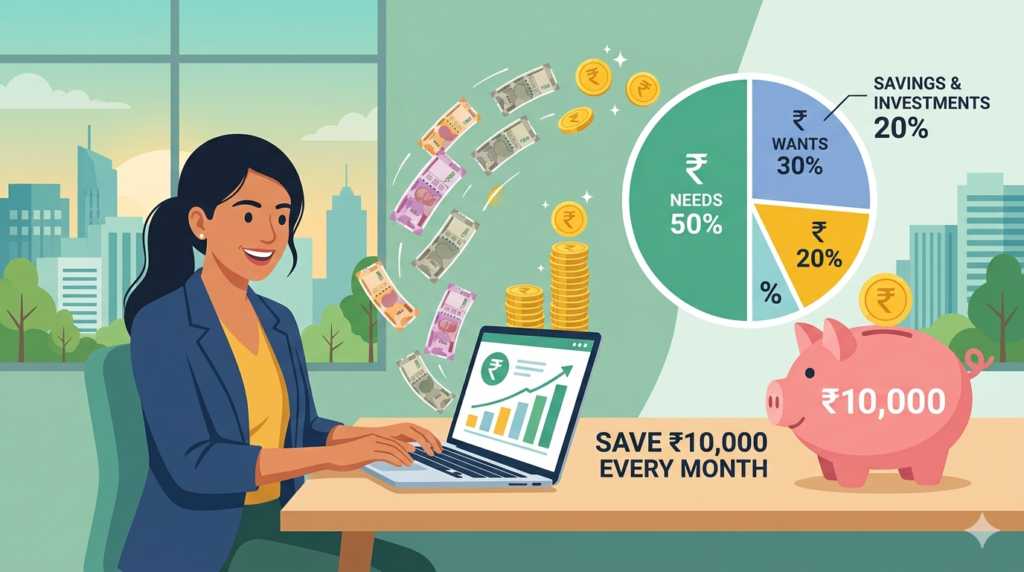
The classic 50-30-20 rule works perfectly on ₹50,000:
- 50% Needs → ₹25,000 (rent, food, transport, bills, EMIs)
- 30% Wants → ₹15,000 (dining out, movies, shopping)
- 20% Savings & Investments → ₹10,000 (exactly your target!)
Some experts recommend a modified 60-20-20 for higher inflation years: 60% needs, 20% wants, 20% savings. Choose based on your city. In smaller cities, 50-30-20 is easier.
The secret? Automate the 20% savings the day salary credits. Use salary account sweep or UPI to mutual fund apps.
Top 10 India-Specific Practical Saving Tips for 2026
- Use UPI + Google Pay/Samsung Pay rewards: Many banks give 1-5% cashback on UPI. Track every rupee automatically.
- Switch to local kirana + JioMart/BigBasket combo: Avoid supermarket markups. Save 25–30% on groceries.
- Pre-paid mobile plans + Airtel/Xiomi broadband: ₹299–₹399 plans with unlimited data beat post-paid.
- Public transport + EV two-wheeler if possible: Petrol at ₹102/litre in 2026 hurts. Monthly metro pass saves thousands.
- No-credit lifestyle: Avoid EMIs on phones, bikes, or gadgets unless emergency. Cash or debit only.
- Weekend cooking challenges: Challenge yourself to cook restaurant-style meals at home. Saves ₹3,000+ on Swiggy/Zomato.
- Second-hand + OLX culture: Buy gadgets, furniture, bikes second-hand. Sell what you don’t use.
- Health insurance + term plan first: Don’t skip — one hospital bill can wipe 2 years of savings.
- Track every expense for 30 days: Awareness alone cuts 15–20% spending.
- Side income experiment: Use weekends for freelancing on Upwork or teaching on UrbanPro. Even ₹3,000 extra helps hit ₹10k savings faster.
Common Mistakes That Kill Your Savings (Avoid These in 2026)
- Emotional spending: “I deserve this” after a tough week → death of savings.
- EMI traps: 0% EMI on phones and appliances is still expensive when you factor opportunity cost.
- Lifestyle inflation: Promotion or bonus? Don’t increase rent or buying power immediately.
- No emergency fund: Unexpected bike repair or medical bill forces you to dip into savings.
- Ignoring taxes & PF: Always check actual take-home, not gross salary.
Real-Life Case Study: How Priya Saved ₹10,000+ on ₹48,000 Take-Home
Priya, 28, works as a marketing executive in Bengaluru. Her take-home was ₹48,000 in early 2026. She was saving only ₹1,500/month.
After following this exact plan:
- Moved to a shared 2BHK in Whitefield (₹9,000 share)
- Started cooking + meal prep (food bill ₹5,800)
- Switched to metro + Rapido (₹1,600)
- Automated ₹10,000 SIP on salary day
Result: In 3 months she was consistently saving ₹11,200/month. In 12 months, her emergency fund reached ₹80,000 and investments crossed ₹1.3 lakh. She says: “It felt impossible until I made it automatic.”
Where to Invest the Saved ₹10,000 Every Month (2026 Options)
Don’t just park it in savings account (4–5%). Here’s the smartest allocation for beginners:
| Goal | Amount | Option | Expected Return (2026) |
|---|---|---|---|
| Emergency Fund (first 3–6 months) | ₹3,000 | Liquid fund / High-interest savings | 6.5–7.5% |
| Long-term Wealth (Retirement / House) | ₹5,000 | Equity Mutual Fund SIP (Flexicap / Nifty 50 Index) | 12–15% historical |
| Tax-saving + Safe | ₹1,000 | PPF or ELSS | 7.1% / 12%+ |
| Short-term Goals | ₹1,000 | Recurring Deposit or Corporate FD | 6.5–8% |
Recommended platforms: Groww, Zerodha Coin, or ET Money (zero commission). Start with index funds for beginners — low risk, high reward over 7+ years.
Important: EPF (if your company contributes) already gives 8.25% tax-free in 2026. Never withdraw early.
Best Tools & Apps to Track Expenses in India (2026)
- ET Money / Groww: Best all-in-one — expense tracking + SIP investment
- Money Manager Expense & Budget (Realbyte): Simple, powerful offline tracking
- Jupiter Money: Modern banking + built-in budgeting
- Wallet by BudgetBakers: Excellent reports and forecasts
- Google Sheets template (free): Custom India 50-30-20 tracker
Pro move: Link your bank account so expenses auto-categorize via UPI SMS.
Frequently Asked Questions
Yes — by sharing accommodation and cooking at home. Many are doing it right now in 2026.
Start with ₹5,000–₹7,000 target and scale up. The system works at any salary above ₹35k.
Build 3 months emergency fund first, then invest aggressively.
Yes. Index funds and flexicap funds have given 12–18% average over 10+ years.
Automate savings first. Treat increased income as “future savings,” not spending money.
Final Words: Your ₹10,000/Month Journey Starts Today
Saving ₹10,000 every month on a ₹50,000 salary isn’t about deprivation — it’s about making smarter choices that Indian middle-class families have been perfecting for decades.
You now have the complete blueprint: mindset, budget, hacks, investments, and tools. The only thing left is action.
Take the first step today: Open your expense tracker app and log every rupee for the next 30 days. Then automate that ₹10,000 transfer on salary day.
In one year, you’ll thank yourself when you have ₹1.2 lakh+ in the bank and growing investments.
Ready to transform your finances in 2026?
Join 50,000+ readers getting weekly personal finance tips India, budgeting templates, and market updates — completely free.
Subscribe to the Newsletter & Get Free 50-30-20 Excel TemplateZero spam. Unsubscribe anytime. Built for ambitious Indians like you.
Written with real 2026 data • Updated April 2026 • For educational purposes. Consult a SEBI-registered advisor for personal advice.

Prasad Govenkar is an experienced enterprise architect with over 24 years of industry expertise, specializing in telecom BSS solutions and large-scale technology transformations. Alongside his professional career in the technology domain, he has developed a strong passion for personal finance, investing, and wealth
Through InvestIndia.blog, Prasad shares practical, easy-to-understand insights to help individuals take control of their financial future. His approach combines analytical thinking from his engineering background with real-world investing experience, making complex financial concepts simple and actionable.