Why Most Investors Underperform the Funds They Invest In (And How to Stop Doing It)
Reading time: 9 min | Category: Investor Behaviour | Last updated: March 2026
>
Imagine this. You invest in a mutual fund that delivers 16% annualised returns over five years. Your friend invested in the exact same fund on the exact same day. Five years later, your portfolio shows 9% annualised growth. His shows 14.5%. Same fund. Same time period. Very different outcomes.
This is not a hypothetical. It happens constantly across India, and across every market in the world. Research from Morningstar and AMFI data consistently shows that the returns investors actually earn lag significantly behind the returns the fund officially delivers. The gap — sometimes called the “behaviour gap” — is the single most expensive mistake retail investors make.
The fund is not the problem. The investor is. And that is actually good news, because investor behaviour is something you can change.
1. What the behaviour gap is and why it exists
2. The exact psychological traps that erode investor returns
3. The data behind underperformance in Indian mutual funds
4. What you must do differently — practical, specific steps
5. When not to rely on Google and when to call an expert instead
What Is the Behaviour Gap and Why Should You Care?
The behaviour gap is the difference between the return a fund earns and the return an investor in that fund actually experiences. Financial advisor Carl Richards popularised this term, but the concept is documented by decades of research across global markets.
In the context of Indian mutual funds, here is a simplified way to understand it. A fund’s published CAGR is calculated from a fixed start point to a fixed end point. It assumes you stayed invested throughout. But almost no one stays fully invested throughout. People invest more when markets look promising, pull out when markets crash, switch funds when they see a “better” option trending on social media, and restart SIPs only after markets have already recovered significantly.
Every one of those decisions quietly chips away at your actual return. The published CAGR stays the same. Your portfolio doesn’t.
A Real-World Example From the Indian Market
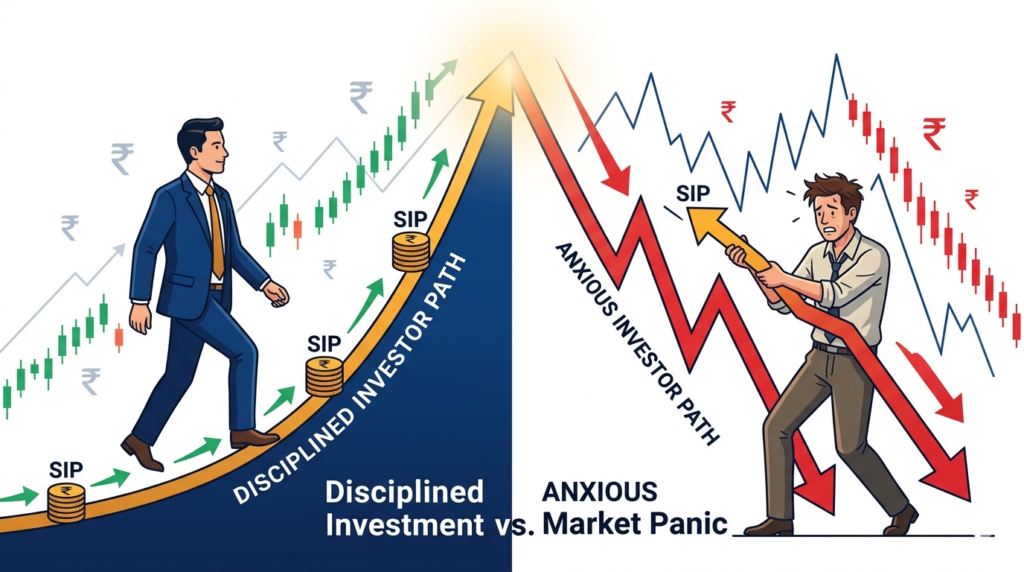
Think about March 2020. The Sensex fell nearly 38% in roughly 40 trading sessions. Millions of Indian SIP investors either paused their SIPs, redeemed their holdings, or both. The investors who stayed invested and even added more saw extraordinary recovery gains over the next 18 months. The investors who panicked and exited missed those gains entirely. When they re-entered — typically after the market had already recovered 30–40% — they locked in their losses and missed the upside.
The fund’s five-year CAGR looked great on paper. The investor’s actual return told a very different story.
You can read more about how smart investors responded to that exact scenario in this article on our blog: The 40% Crash That Made One Man Rich and Left His Friend Behind.
The Six Psychological Traps That Cost Investors Real Money
No investor consciously decides to destroy their own returns. These traps are built into how the human brain works. Understanding them is the first step to disarming them.
1. Recency Bias — Chasing Last Year’s Winner
The most common investing mistake in India. An investor sees that a small-cap fund returned 45% last year. He moves his money there — just as that segment begins its mean-reversion phase. He sells his previous holding at a loss, buys at a high, and experiences the subsequent correction fully. The fund he left often recovers and does well. The fund he bought corrects. He has accomplished the opposite of what he intended.
Recency bias makes recent performance feel like a reliable predictor of future performance. It is not. SEBI mandates the disclaimer “past performance is not indicative of future returns” on every fund document for a reason.
2. Loss Aversion — Feeling Losses Twice as Sharply as Gains
Nobel laureate Daniel Kahneman’s research showed that the psychological pain of losing ₹10,000 is roughly twice as powerful as the pleasure of gaining ₹10,000. This asymmetry causes investors to make irrational decisions during market downturns. They sell funds that are temporarily down, locking in losses, to escape the emotional discomfort — even when staying invested is clearly the rational choice.
3. Action Bias — The Urge to Do Something
When markets fall, doing nothing feels irresponsible. There is a deep human impulse to act, to take control, to “fix” things. In investing, acting when markets fall usually means selling — which destroys returns. The best investors are often the most disciplined at inaction. Patience is a strategy, though it rarely feels like one.
4. Overconfidence — Everyone Thinks They Can Time the Market
Surveys consistently show that individual investors rate their own abilities well above average. In reality, even professional fund managers with access to institutional-grade research fail to consistently time the market over long periods. The retail investor who checks Zerodha and reads financial Twitter has almost no structural edge. Yet the confidence remains — and it leads to excessive trading, premature exits, and missed compounding.
5. Herd Mentality — Following the Crowd Off the Cliff
When everyone around you is buying — friends, relatives, WhatsApp groups, influencers — it feels irrational not to buy. When everyone is panicking and selling, holding feels dangerous. This herd dynamic is why individual investors tend to buy near market peaks and sell near market bottoms. They are doing the opposite of what creates wealth.
6. The Fund-Switching Trap — Portfolio Churning
Many investors treat their mutual fund portfolio like a fantasy cricket team — constantly swapping players based on recent form. Every switch triggers exit loads (if applicable), potential capital gains tax, and a break in compounding continuity. More importantly, the investor is repeatedly buying funds that have already performed and selling funds that are temporarily underperforming — exactly backwards from what works.
The fund you switch out of almost never stops performing after you leave. The fund you switch into almost never continues its recent run. Most investors have experienced this personally and still repeat the same mistake.
What the Data Actually Shows
Morningstar’s annual “Mind the Gap” study — which measures the difference between total returns of funds and the dollar-weighted returns investors actually earned — consistently finds a gap of 1% to 2.5% per year across most fund categories. Over 20 years, that gap compounds into a staggering wealth difference.
A 1.5% annual behaviour gap on ₹10 lakh invested over 20 years at 12% market returns looks like this:
| Scenario | Annual Return | Final Corpus (20 yrs) |
|---|---|---|
| Fund’s actual return (stayed invested) | 12% | ₹96.46 lakh |
| Investor’s real return (behaviour gap of 1.5%) | 10.5% | ₹74.60 lakh |
| Wealth lost to behaviour | — | ₹21.86 lakh |
More than ₹21 lakh — lost not to the market, not to the fund manager’s decisions, but to the investor’s own behaviour. That is the real cost of emotional investing.
Why SIP Is the Right Answer — But Only When You Don’t Tamper With It
A Systematic Investment Plan is one of the most effective tools to counter investor psychology — but only when it is left alone. The entire mathematical advantage of SIP comes from disciplined, uninterrupted investment across market cycles. When you pause it during corrections (the exact time it is working hardest for you) or stop it during poor market phases, you are defeating the very mechanism that makes SIP powerful.
The reason SIP works is that it buys more units when markets are down and fewer units when markets are up. This automatic averaging over time is called rupee-cost averaging. The moment you interfere with the SIP based on market conditions, you break that averaging mechanism.
If you are still building your SIP habit or starting fresh, this step-by-step guide is worth reading: How to Start SIP Investment in India for Beginners: A Complete Step-by-Step Guide (2026).
The News Cycle Problem: Why Following Financial News Hurts Returns
There is an uncomfortable truth about financial media: it exists to generate engagement, not to help you build wealth. Alarming headlines drive clicks. Predictions of market crashes and bull runs drive attention. Very little of it is actionable for a long-term investor.
Research from the University of California found that investors who checked their portfolio more frequently earned measurably lower returns than those who checked less frequently. More information, in investing, does not lead to better decisions. For most retail investors, it leads to more frequent trading — and more frequent mistakes.
This applies equally to YouTube finance channels, Telegram stock tips groups, and even well-meaning family members who share WhatsApp forwards about which fund to buy. None of them know your financial situation. None of them are accountable for the outcome. You are.
When Googling for Financial Advice Is the Wrong Move
The internet has made financial information far more accessible. That is largely a good thing. But there is a meaningful difference between financial information and financial advice — and confusing the two can cost you significantly.
Google can tell you what ELSS stands for. It cannot tell you whether ELSS is the right tax-saving instrument for your specific income, tax bracket, existing investments, liquidity needs, and financial goals. The first is information. The second is advice.
Specific situations where you should speak to a qualified expert — not Google:
1. You are investing a large lump sum — Inheritance, business sale proceeds, retirement corpus, or any amount that represents a significant portion of your net worth. The entry strategy matters enormously and is highly individual.
2. You are nearing or entering retirement — Asset allocation for retirement drawdown is complex. Sequence-of-returns risk is real and not widely understood. A mistake here is very hard to recover from.
3. You are making decisions under emotional pressure — If markets have just fallen 20% and you are considering exiting, you need a second opinion from someone who is not emotionally involved. That person is not Google. That person is a qualified fee-only financial planner.
4. Your tax situation is complex — Multiple income sources, business income, NRI status, or significant capital gains all require a tax expert, not a generic online article.
5. You are planning for a specific life goal — Children’s education abroad, early retirement at 45, or buying property within 3 years all need structured financial planning — not a search query.
In India, look for a SEBI-registered investment adviser (RIA) who charges a fee for advice — not one who earns commissions on the products they sell you. The SEBI RIA database is publicly accessible and a good starting point. A fee-only planner’s incentives are aligned with yours.
What Investors Who Actually Outperform Do Differently
This is not mysterious. The investors who come closest to capturing the fund’s actual return share a few consistent behaviours.
They define their investment horizon before they invest. Not “long term” as a vague idea — a specific number of years for which this money will not be needed. This makes short-term market movements emotionally manageable.
They automate everything they can. SIPs are set on auto-debit. Rebalancing happens on a calendar schedule, not based on market signals. Removing the need to make active decisions removes the opportunity to make bad ones.
They check their portfolio infrequently. Quarterly, at most. Sometimes annually. They review to rebalance — not to react.
They choose boring over exciting. Consistent, diversified funds over thematic funds that dominate short-term headlines. Broad market index funds and large-cap equity funds do not make for exciting dinner conversation — but they build real wealth over time. Investors interested in index fund options can explore this detailed breakdown: Best Index Funds in India for Long Term: Top Picks, Returns and How to Choose.
They never invest money they might need within three years in equity. When the money you have invested might be required soon, you are forced to sell at whatever price the market offers — not the price you want. This single discipline prevents a large percentage of panic selling.
Quick Reference: Key Concepts Explained
What is investor underperformance?
Investor underperformance occurs when the returns an investor actually earns from a mutual fund are lower than the fund’s officially published return. This gap — typically 1% to 2.5% per year — arises from emotional decisions like panic selling, fund switching, and poor timing of investments rather than any fault in the fund itself.
How does the behaviour gap work?
The behaviour gap works by measuring the difference between a fund’s time-weighted return and an investor’s money-weighted return. When investors buy after rallies and sell during corrections — which is the most common pattern — they consistently receive less than the fund’s headline return, even in a fund that is performing exactly as intended.
Who is most likely to underperform their funds?
Investors who follow financial news intensely, check their portfolios daily, switch funds frequently based on recent performance, or stop SIPs during market downturns are most likely to experience significant underperformance. First-time investors without a written financial plan are particularly vulnerable during their first major market correction.
What are the main risks of emotional investing?
Emotional investing carries the risks of locking in losses at market bottoms, missing recovery gains after exit, paying unnecessary taxes on short-term capital gains, incurring exit loads on premature redemptions, and permanently compressing the long-term compounding trajectory. The financial cost over 20 years can easily exceed ₹20–30 lakh on a modest investment.
Key Takeaways
1. The gap between what a fund earns and what its investors earn is real, measurable, and costly.
2. The cause is almost always investor behaviour — not the fund, not the fund manager, not the market.
3. Recency bias, loss aversion, overconfidence, herd mentality, and action bias are the six primary culprits.
4. SIP is powerful — but only when left uninterrupted. Pausing during corrections defeats its core advantage.
5. Checking your portfolio less often, not more, leads to better returns for most investors.
6. Financial information from Google is useful. Financial advice specific to your situation must come from a qualified human professional.
7. Automation, a clear investment horizon, and deliberate inaction are the behaviours that close the gap.
For further reading on investor psychology and fund performance data, the Morningstar Mind the Gap study is one of the most comprehensive annual analyses on this topic. SEBI’s investor behaviour research reports also offer detailed data specific to Indian retail investors.
Frequently Asked Questions
Q: My mutual fund shows 15% CAGR but my portfolio XIRR is only 9%. Is something wrong with the fund?
Almost certainly not. The fund’s CAGR is calculated assuming someone stayed fully invested throughout the entire period. Your XIRR reflects the actual timing and amounts of your investments and withdrawals. If you added money after market rallies, pulled out during corrections, or switched funds during downturns, those decisions are fully captured in your XIRR. The fund performed fine. The timing of your participation in that performance is what dragged your number down.
Q: Is it ever right to stop a SIP?
Yes — but the reason should be personal and financial, not market-related. If you have a genuine cash flow crisis, medical emergency, or job loss, pausing a SIP may be necessary. What is never a good reason to stop a SIP is a market correction. That is precisely when your SIP is buying units at a discount and doing exactly what it is designed to do.
Q: How often should I review my mutual fund portfolio?
For most investors, once every six months is enough. A full annual review is ideal. The purpose of a review is to check whether your fund is fundamentally different from when you chose it — a change in fund manager, a significant shift in the fund’s investment mandate, or a major change in your own financial goals. Short-term underperformance relative to a benchmark is not a valid reason to switch funds.
Q: Can index funds solve the behaviour gap problem?
Partly. Index funds remove the temptation to switch based on fund manager performance or peer comparison — since there is no active manager to blame or credit. They also have lower costs, which reduces the structural drag on returns. However, they do not automatically prevent the investor from panic-selling during a crash. The behaviour gap is a human problem, not a product problem. A well-chosen index fund invested in consistently still beats a well-chosen active fund invested in inconsistently.
Q: What is the single most important thing I can do to improve my actual investment returns?
Define your investment horizon before you invest — and write it down. When you know that this money is for retirement in 18 years and you genuinely will not need it before then, a 20% market correction becomes contextually insignificant. Most panic-driven decisions happen when investors have not defined how long the money can stay invested. Clarity of purpose is the cheapest and most effective return enhancer available.
The Fund Was Never the Problem
Most conversations about investing in India focus on which fund to pick. That is the wrong conversation to start with. Before you pick a fund, you need to pick the investor you are going to be — patient or reactive, disciplined or emotional, long-term focused or distracted by every market movement.
The fund you choose matters less than how you behave inside that fund across market cycles. A mediocre fund held patiently through multiple market corrections will almost always deliver better results than an excellent fund held impatiently and switched out at the first sign of trouble.
The investors who build real wealth in India are not necessarily the ones who found the best fund. They are the ones who found a decent fund and then had the discipline to leave it alone.
If you are wondering how to structure your broader wealth-building approach, this article on our blog lays out a clear framework: Why Most Indians Never Build Real Wealth — And How SIPs Can Change That.
Your job as an investor is not to predict what the market will do next. Your job is to ensure that whatever the market does next, your response to it does not cost you the returns you were already on track to earn.
This article is for educational purposes only and does not constitute investment advice. Please consult a SEBI-registered investment adviser before making any financial decisions.

Prasad Govenkar is an experienced enterprise architect with over 24 years of industry expertise, specializing in telecom BSS solutions and large-scale technology transformations. Alongside his professional career in the technology domain, he has developed a strong passion for personal finance, investing, and wealth
Through InvestIndia.blog, Prasad shares practical, easy-to-understand insights to help individuals take control of their financial future. His approach combines analytical thinking from his engineering background with real-world investing experience, making complex financial concepts simple and actionable.