Government Schemes That Can Make You Rich (PLI, Infrastructure, and More)
Imagine a factory in Gujarat doubling its mobile phone exports every year. Or a highway contractor in Maharashtra seeing order books swell by 30% in just six months. This is not a distant dream—it is happening right now because of bold government policies.
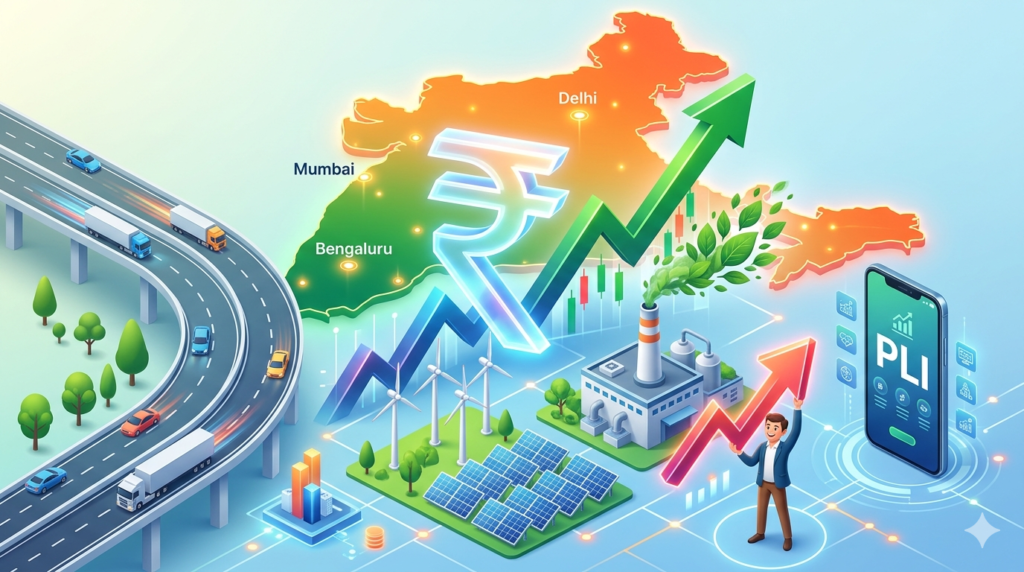
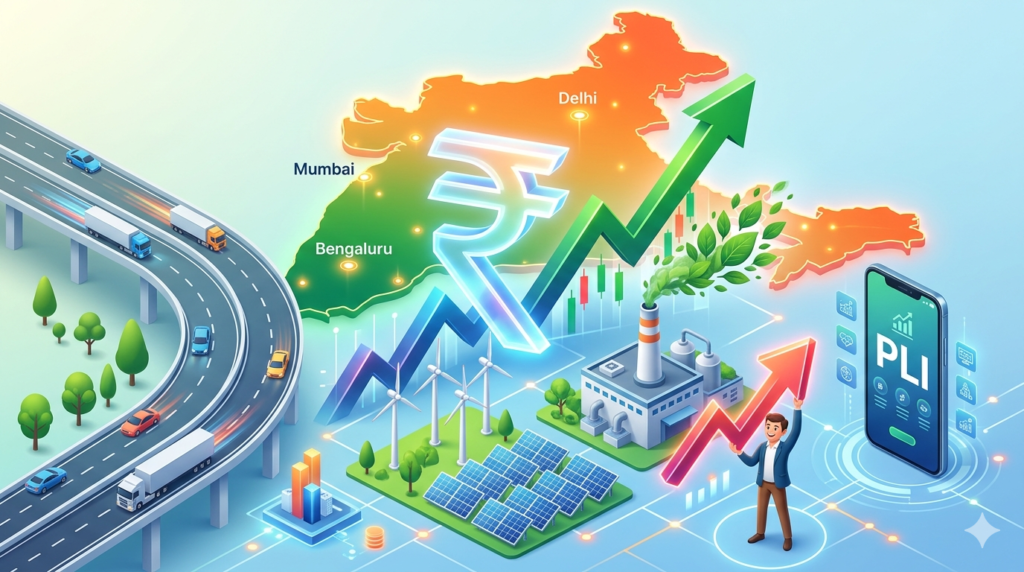
India is in the midst of a historic economic transformation. With a ₹1.97 lakh crore Production Linked Incentive (PLI) scheme and a ₹12.2 lakh crore infrastructure push for 2026-27, the government is laying a red carpet for wealth creation. But here’s the big question: How can YOU, as a common investor, ride this wave?
In this guide, we decode the top government schemes and give you a step-by-step blueprint to profit from India’s growth story. No jargon. Just simple, actionable insights.
1. Why Government Policies Are the New Wealth Engines
For decades, Indian retail investors relied on fixed deposits or gold. But today, policy-driven growth is changing the game. When the government announces a scheme like PLI or a massive highway project, it directly impacts corporate earnings, stock prices, and job creation.
Consider this: Between FY21 and FY25, exports from PLI-covered sectors grew at an average annual rate of 10.6% [citation:2]. That means companies in these sectors saw higher revenues, better profits, and rising stock valuations. For the smart investor, aligning your portfolio with government priorities is like sailing with the wind.
2. Production Linked Incentive (PLI): The Game Changer
Launched in 2020, the PLI scheme is India’s masterstroke to become a manufacturing hub. Simply put, the government gives companies a financial incentive (4% to 6% of sales) for every product they make and sell in India or export. This encourages global giants like Apple, Samsung, and local champions like Dixon to set up mega-factories here.
How It Creates Wealth
When a company receives PLI benefits, its profit margins expand. More profits → higher earnings per share (EPS) → stock price appreciation. Additionally, job creation boosts consumption, benefiting banks and FMCG stocks.
Key Sectors Under PLI (14 Sectors)
- Electronics & IT Hardware: Exports grew 38.8% CAGR (FY21-25) [citation:2].
- Pharmaceuticals & Medical Devices: Focus on self-reliance for APIs and bulk drugs.
- Automobiles & EV Components: ACC battery exports up 45% CAGR.
- Textiles & Apparel: ₹10,683 crore outlay, now expanding to MMF and technical textiles [citation:10].
- Food Processing: ₹9,207 crore investment by 165 firms (Nestle, ITC, Amul) [citation:6].
- Speciality Steel & Drones: Strategic sectors for defense and infrastructure.
📊 Table 1: PLI Sectors & Investment Opportunity
| Sector | Outlay (₹ Crore) | Export Growth (CAGR) | Potential Beneficiaries |
|---|---|---|---|
| Electronics (Mobile/IT) | ~40,000 | 38.8% | Dixon, Amber, Tata Electronics |
| Pharma (APIs, Biosimilars) | 15,000 | 6% | Sun Pharma, Dr Reddy’s, Biocon |
| ACC Batteries (EV) | 18,100 | 45% | Exide, Amara Raja, Reliance New Energy |
| Textiles (MMF, Technical) | 10,683 | 7.8% | Trident, Vardhman, Welspun |
| Food Processing | 10,900 | 10.58% (Sales) | ITC, Britannia, Haldiram’s, Tata Consumer |
Actionable takeaway: Look for listed companies that have announced capacity expansion under PLI. Their revenue visibility is strong for the next 5-6 years.
3. Infrastructure Boom: The Concrete Path to Profits
India is building at an unprecedented pace. From the Delhi-Mumbai Expressway to 100+ new airports, and from dedicated freight corridors to green energy parks — the government is spending heavily. The Economic Survey 2026 confirms that infrastructure investment has a multiplier effect of 2.5 to 3x on GDP.
Where Is the Money Going?
- Roads & Highways: NHAI targets 50,000 km of new roads by 2027 [citation:7].
- Railways: ₹2.5 lakh crore modernization plan over a decade (Vande Bharat trains, electrification).
- Renewable Energy: 500 GW non-fossil capacity by 2030; ₹40 lakh crore capex needed [citation:7].
- Urban Infrastructure: PM Awas Yojana (housing for all) and metro rail expansion in 27 cities.
🏗️ Table 2: Infrastructure Sectors & Growth Potential
| Sector | Govt Push | Growth Drivers | Top Stocks (Indicative) |
|---|---|---|---|
| Roads & EPC | ₹12.2 lakh crore (FY26 Capex) | Order book surge, hybrid annuity model (HAM) | L&T, IRB Infra, KNR Constructions |
| Railways | ₹2.5 lakh crore (10-yr plan) | Vande Bharat, freight corridors, station redevelopment | RVNL, Titagarh Wagons, Siemens |
| Renewable Energy | 500 GW target by 2030 | Solar, wind, green hydrogen, CCUS (₹20k cr allocation) | Adani Green, NTPC Green, Tata Power, Suzlon |
| Defence | ₹4.92 lakh crore (Budget FY26) | Indigenisation (PLI for drones, ammunition) | BEL, HAL, BDL, Mazagon Dock |
4. Beyond PLI: Make in India, Digital India & EV Push
Wealth creation isn’t limited to manufacturing. The government’s holistic approach includes:
- Make in India 2.0: Focus on MSMEs, defence production, and industrial corridors.
- Digital India: UPI transactions, data centres, AI & cybersecurity. IT sector expected to reach $350 billion by 2026 [citation:8].
- FAME & EV Ecosystem: Subsidies for electric two-wheelers, buses, and charging stations. This benefits battery makers (Exide, Amara Raja) and EV OEMs (Ola Electric, Tata Motors).
- Startup India: Tax holidays and funding support. While risky, successful startups like Zomato, Nykaa, and Paytm have created massive wealth for early investors.
5. Your Action Plan: 4 Ways to Invest in India’s Growth Story
You don’t need crores to benefit. Even ₹500 per month can get you started.
✅ 1. Direct Stocks (For high-risk appetite)
Pick sector leaders benefiting from PLI/infra. Example: L&T for construction, Dixon for electronics, NTPC for power. Use a SIP in stocks (accumulate monthly) to average volatility.
✅ 2. Sectoral/Thematic Mutual Funds
Funds like Infrastructure Funds, Manufacturing Funds, or PSU Funds hold a basket of related stocks. E.g., Axis BSE India Sector Leaders Index Fund tracks top 3 leaders across 20+ sectors [citation:8].
✅ 3. Exchange Traded Funds (ETFs)
ETFs like Bharat 22, CPSE ETF, or Infra BeES give you diversified exposure at low cost. They are traded like stocks on the exchange.
✅ 4. Long-term Wealth Strategy (7-10 years horizon)
Combine 50% large-cap growth (beneficiaries of formalisation) + 30% mid-cap/small-cap (PLI winners) + 20% debt for stability. Rebalance annually.
📋 Table 3: Investment Options Comparison
| Instrument | Risk Level | Expected Returns (CAGR) | Best For | Minimum Investment |
|---|---|---|---|---|
| Direct Equity (Stocks) | High | 15-20% (potential) | Active investors who track markets | ₹500 (per stock SIP) |
| Thematic MF (Infra/PLI) | Moderate-High | 12-16% | Those wanting professional management | ₹500 (SIP) / ₹1000 (Lumpsum) |
| ETFs (Bharat22, CPSE) | Moderate | 10-14% | Low-cost passive investors | Price of 1 unit (~₹30-₹100) |
| Public Provident Fund (PPF) | Very Low | 7-8% (tax-free) | Risk-averse, long-term savers | ₹500 |
6. Real Examples: From Policy to Profit
Let’s make this concrete with real numbers from government data.
📱 Example 1: Electronics Manufacturing Boom
Thanks to PLI, India’s mobile phone exports jumped from negligible to $20.5 billion in 2024. A company like Dixon Technologies saw its stock price skyrocket from ₹2,000 (2020) to over ₹15,000 (2025) — a 7x return! [citation:8]
🏭 Example 2: Food Processing Surge
PLI in food processing attracted ₹9,207 crore investment from 165 firms including ITC, Nestle, and Amul. Sales of PLI-supported products grew at 10.58% CAGR. Investors in ITC and Britannia saw steady double-digit returns with low volatility [citation:6].
⚡ Example 3: Green Energy Revolution
With a target of 500 GW renewable energy by 2030, companies like Adani Green and NTPC Green are expanding capacity at breakneck speed. The government’s CCUS allocation of ₹20,000 crore over 5 years opens opportunities in carbon capture [citation:3].
7. The Reality Check: Risks You Cannot Ignore
While the opportunity is massive, investing based on government schemes has its pitfalls.
- Execution Delays: Infrastructure projects often face land acquisition issues, regulatory hurdles, or contractor defaults.
- Policy Changes: An election year could shift priorities. However, PLI and infra have bi-partisan support.
- Global Headwinds: A recession in the US or Europe can hurt export-oriented PLI sectors (IT, pharma, auto).
- Valuation Bubbles: Some infrastructure and PSU stocks trade at high P/E ratios (25-30x). Buying at peak can lead to multi-year underperformance.
Solution: Diversify across sectors, invest via SIPs to average cost, and maintain a long-term horizon (minimum 7 years).
8. Step-by-Step Investment Blueprint for 2026
Ready to start? Follow this simple monthly plan:
- Step 1 (Set aside emergency fund): 6 months of expenses in FD/liquid fund.
- Step 2 (Open demat account): Use SEBI-registered brokers like Zerodha, Groww, or Angel One.
- Step 3 (Allocate 70% to core themes):
- 30% in Infrastructure ETFs (e.g., Infra BeES or CPSE ETF).
- 30% in Manufacturing/PLI focused mutual fund (e.g., ICICI Manufacturing Fund).
- 10% in PSU/Defense fund.
- Step 4 (Allocate 30% to direct stocks): Pick 5-10 stocks from PLI/infra leaders after researching their order books and debt levels.
- Step 5 (Review quarterly): Track budget announcements, quarterly results, and management commentary.
Pro Tip: Start a small SIP of ₹1000-₹2000 in an infrastructure fund today. Increase it by 10% every year. Time is your biggest ally.
❓ Frequently Asked Questions (FAQ)
The Production Linked Incentive (PLI) scheme offers companies financial incentives based on incremental sales and exports over 5-6 years. Launched in 2020 with a ₹1.97 lakh crore outlay across 14 sectors, it aims to boost manufacturing, attract investment, and create jobs. Companies meeting production targets receive 4-6% cashback on sales.
Retail investors can invest through infrastructure-focused mutual funds, ETFs like Bharat 22 or Infra BeES, or directly in stocks of leading EPC companies (L&T, IRB Infrastructure), capital goods (Siemens, Cummins), and PSU banks financing these projects. Even a ₹500 monthly SIP is enough to start.
Electronics manufacturing (mobile exports up 38.8% CAGR), renewable energy (ACC batteries 45% growth), pharmaceuticals, specialty steel, textiles, food processing, and EV ecosystem are top beneficiaries. Also, defense and railway modernisation are seeing massive order inflows [citation:2][citation:7].
Yes. While policy tailwinds exist, risks include execution delays, global commodity price volatility, geopolitical factors (China+1 may reverse), and sector-specific cyclical downturns. Diversification via mutual funds, asset allocation (equity+debt+gold), and a long-term horizon (7+ years) is recommended.
PLI focuses on boosting domestic manufacturing across 14 sectors (including EVs and components) through production-linked subsidies. FAME India (Faster Adoption and Manufacturing of Electric Vehicles) specifically promotes electric mobility adoption by offering incentives on EV purchases and setting up charging infrastructure. Both complement each other for the EV ecosystem.
📚 Further Reading: Invest India Blog (Home) | Deep Dive: PLI Electronics Scheme | How InvITS Can Give Regular Income from Infra
🔗 Official Sources & References: Press Information Bureau (PIB) | Reserve Bank of India | SEBI Investor Education