
Real Monthly Budget of a ₹30,000 Salary Household in India
No sugar-coating. No generic advice. Just an honest, number-by-number breakdown of how real families actually survive — and sometimes thrive — on thirty thousand rupees a month.
Picture this: It’s the 3rd of the month. Ramesh, a 28-year-old junior accountant in Pune, checks his bank account after his salary just landed — ₹30,000 exactly. For about 11 seconds, he feels wealthy. Then his phone lights up: rent reminder, grocery list from his wife, a WhatsApp from his mother about some medicine, and a notification that his bike EMI is due on the 5th. The ₹30,000 has already mentally shrunk to ₹12,000.
Sound familiar? If you’re living on or managing a ₹30,000 monthly salary household anywhere in urban or semi-urban India, you know this feeling intimately. It’s that peculiar tension between “I earn a decent salary” and “I have no idea where it all goes.”
This article isn’t going to tell you to “make a budget” or “cut your chai habit.” That advice is as useful as telling someone drowning to “swim harder.” Instead, we’re going to do a real, ground-level deep dive into what a ₹30,000 household actually spends, where the money silently leaks, and — most importantly — what genuinely realistic steps look like when your margin for error is slim.
Who Exactly Is This “₹30,000 Household”?
Before we start slicing the salary like a wedding cake, let’s understand who we’re actually talking about. A ₹30,000-per-month household in India typically looks like one of these:
- A single earner with a spouse and one child — the most common setup. One income, three mouths, and the quiet anxiety of a single point of failure.
- A young professional living alone or with a roommate — sharing rent, splitting groceries, and convincing themselves they’ll “start investing next month.”
- A couple where both work but one earns ₹30k and the other earns less — technically two incomes, but functionally one and a half.
The geographic location matters enormously. ₹30,000 in Lucknow or Coimbatore gives you breathing room. ₹30,000 in Mumbai or Bengaluru gives you mild panic attacks. We’ll address both realities, but our primary lens will be a Tier-2 city household with some Tier-1 context for comparison.
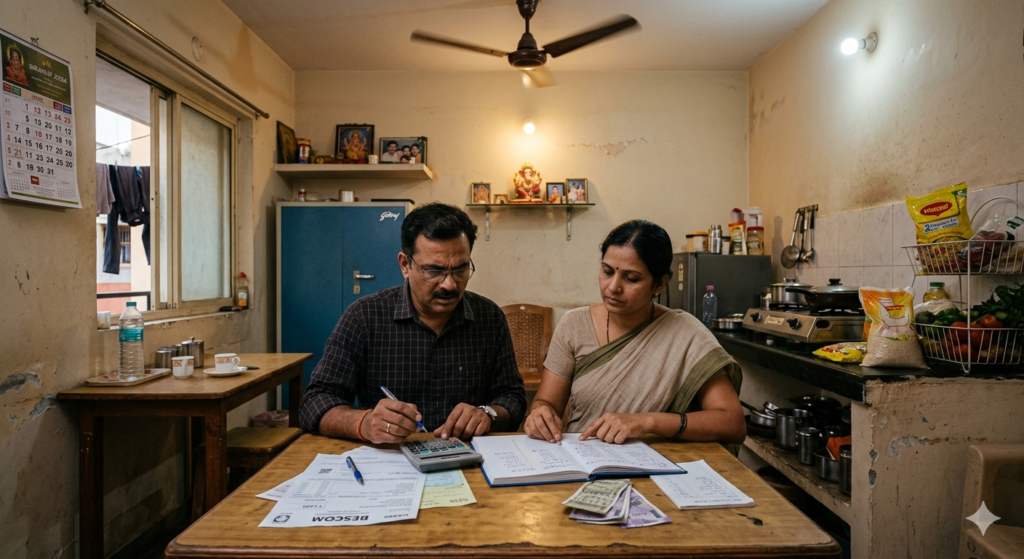
Meet Ramesh & Priya — A Real-ish Household
Ramesh, 28 — Junior accountant, Pune. Take-home salary: ₹30,000/month.
Priya, 26 — Homemaker (recently quit her ₹12,000 BPO job due to their toddler).
Kavya, 2.5 years — Toddler. Primary reason for all financial decisions, good and bad.
They live in a 1 BHK in Wakad, Pune — not the swanky part, but decent enough. Ramesh commutes 14 km to work on a Honda Activa he’s still paying EMI on. They have no inherited property, no financial safety net from parents (his parents are in the village, her parents are retired), and zero savings as of six months ago when they had to wipe out their emergency fund for a hospital bill.
This is about as real as it gets.
The Actual Monthly Budget: Where Every Rupee Goes
Let’s run through the real numbers. Not the aspirational ones from financial planning apps. The actual ones, including the ₹500 that “just disappeared somehow.”
| Expense Category | Item / Detail | Monthly Amount (₹) |
|---|---|---|
| Housing | 1 BHK rent (Tier-2 city, decent area) | 8,000 |
| Electricity bill | 700 | |
| Water / maintenance charges | 300 | |
| Food & Groceries | Monthly kirana + vegetables + dairy | 5,500 |
| LPG cylinder (approx. 1 per month) | 900 | |
| Occasional eating out / Swiggy (let’s be honest) | 800 | |
| Transport | Bike EMI (Honda Activa, 12 months remaining) | 2,200 |
| Petrol (approx. 5–6 litres/week) | 1,000 | |
| Child Expenses | Daycare / playschool (half-day) | 1,800 |
| Diapers, formula, medicines | 1,200 | |
| Mobile & Internet | 2 mobile recharges (Jio/Airtel) | 500 |
| Insurance & SIP | Term insurance premium (monthly) | 700 |
| SIP — if they manage it | 500 | |
| Personal Care | Toiletries, haircut, etc. | 600 |
| Clothing | Occasional (averaged monthly) | 400 |
| Miscellaneous | Medicine, gifts, emergencies, “I don’t know where it went” | 1,400 |
| Total Monthly Expenses | 26,500 | |
| Remaining (Savings Margin) | 3,500 | |
That ₹3,500 “savings” looks great on paper. In real life, about ₹1,500–₹2,000 of it evaporates through unplanned expenses — a sudden dengue fever, a school admission fee, a relative’s wedding contribution. The actual average savings for this household? Closer to ₹1,000–₹1,500 a month, if they’re lucky and disciplined.
The “Survival Mode” Tight Budget: When Things Get Harder
Now let’s talk about the version no one wants to think about but many households actually live. What happens when the bike breaks down, the baby gets sick, or there’s an unplanned visit from relatives? Here’s what the “extreme efficiency” version looks like — the budget that squeezes every paisa:
| Category | Tight Budget Version | Amount (₹) |
|---|---|---|
| Housing | Shared 2 BHK (split rent with another family/couple) | 5,500 |
| Electricity | Shared, minimal AC use | 400 |
| Groceries | Local market, no branded items, batch cooking | 4,200 |
| LPG | One cylinder, careful use | 900 |
| Eating Out | Strictly zero — cook everything at home | 0 |
| Transport | Bike EMI only — no extra trips | 2,200 |
| Petrol | Reduced trips, carpooling where possible | 700 |
| Child | Home-based care, no daycare | 600 |
| Mobile | One smartphone plan, one basic | 350 |
| Insurance | Term insurance only (non-negotiable) | 700 |
| Personal Care | Basics only | 350 |
| Miscellaneous | Hard cap | 700 |
| Total | 16,600 | |
| Surplus for Savings / Emergency | 13,400 | |
The tight budget above is theoretically possible but extremely hard to sustain emotionally. Human beings are not robots. Zero eating out, shared housing, and removing daycare (which means Priya cannot work part-time) creates relationship stress, social isolation, and burnout. This version is a short-term emergency plan, not a lifestyle. Don’t try to live here permanently without a clear exit timeline.
The Honest Challenges Nobody Talks About
Every personal finance article talks about what you should do. Let’s talk about why it’s so hard to do it.
1. The “Just This Once” Problem
In real life, everyone knows they should save. But there’s always a “just this once” moment — a relative’s wedding, a child’s birthday, the neighbor’s kid got new shoes and now your kid needs them too. These aren’t moral failures. They’re deeply social expenses baked into Indian culture. You can’t just tell your in-laws you didn’t contribute to the family puja because you were “building an emergency fund.” That conversation does not go well.
2. The Invisible Inflation of Lifestyle
When Ramesh got a ₹3,000 increment last year, what happened? The rent was upgraded from ₹7,000 to ₹8,000 “because finally we can afford it.” The grocery category silently expanded. The Swiggy orders went from twice a month to four times. This is called lifestyle creep, and it operates like termites — you don’t notice the damage until it’s substantial.
What usually happens is that every income increase is met with a proportional increase in expenses, leaving the savings rate exactly where it was — near zero.
3. No Financial Cushion Means Every Crisis Is a Catastrophe
At ₹30,000 a month, the typical household has somewhere between ₹0 and ₹15,000 in liquid savings. This means any unexpected expense above ₹5,000 — a root canal, a scooter breakdown, a sudden relative visiting — immediately sends them to the “borrow from someone” stage. And borrowed money doesn’t come back easily in this income bracket.
The cruel irony: the people who most need an emergency fund are the ones least likely to have it.
4. The Double Burden of Family Obligations
In this salary range, it’s remarkably common to also be partially supporting parents or siblings back in the hometown. Even ₹2,000–₹3,000 sent home every month — which feels small and “the least you can do” — significantly compresses an already thin margin. There’s no villain here, just the quiet arithmetic of joint family systems meeting nuclear budgets.
“Most people in this salary range aren’t bad at math. They’re overwhelmed by competing, equally valid obligations. The problem isn’t knowledge — it’s bandwidth and margin.”
Common Financial Mistakes at This Income Level
Having worked with and observed many households in the ₹25,000–₹40,000 bracket, here are the patterns that reliably show up — and quietly cause damage:
- Buying insurance as investment: Traditional LIC endowment plans or money-back policies are expensive, low-return traps. A ₹700–₹900 monthly premium going toward a ₹10 lakh endowment plan is a terrible use of scarce money. Separate your insurance (term plan) from your investment (SIP/RD).
- Taking a personal loan to fund a wedding: This is devastatingly common. A personal loan at 15–18% interest for 2–3 years to fund a ₹1.5 lakh wedding can eat ₹4,000–₹5,000 per month for years. That’s a mortgage on a celebration.
- No term insurance at all: Some households skip insurance entirely. If the single earner dies or is incapacitated, the family has no floor. A ₹50 lakh term cover costs as little as ₹600–₹700/month for a 28-year-old. This is the one thing you cannot afford to skip.
- Using the credit card as a salary extension: Credit cards on a ₹30,000 salary create the illusion of a ₹35,000 salary. Until the bill comes. At 36–40% annual interest, this is one of the fastest ways to create a debt spiral.
- Keeping everything in a savings account: A savings account earning 3–4% interest while inflation runs at 5–6% means your money is quietly shrinking every year. Even a recurring deposit or a ₹500 SIP beats doing nothing.
- Not tracking expenses at all: “I roughly know where it goes” is almost never accurate. Most people who track their expenses for the first time are genuinely shocked. Tracking for even 60 days changes behavior without any additional effort.
The Food & Grocery Reality: Where the Numbers Actually Lie
Let’s spend a moment on groceries because this is where most online budget guides get embarrassingly wrong. “Spend ₹3,000 on groceries” is the advice. In reality, a family of three — with a toddler — will spend ₹5,000–₹6,500 easily. Here’s why:
- Vegetables: ₹800–₹1,000 per month (prices have surged dramatically in 2024–25)
- Staples (rice, dal, atta, oil): ₹1,500–₹1,800
- Dairy (milk, curd, paneer occasionally): ₹900–₹1,100
- Child-specific items (Horlicks, biscuits, fruits): ₹700–₹900
- Spices, cleaning supplies: ₹300–₹400
That’s ₹4,200–₹5,200 before you even think about eating out once. The families who claim to “manage in ₹3,000” are either cooking for two adults only, living in a lower cost-of-living city, or significantly under-eating. There is no shame in acknowledging the real cost of food.
Buying vegetables from local sabzi mandis instead of supermarkets saves approximately ₹200–₹300 per week. Over a month, that’s ₹800–₹1,200 saved — enough to fund a small SIP. It takes 20 extra minutes on a Saturday morning. That’s a 600% return on your time.
Rent vs. Shared Housing: The Math Most People Avoid
Housing is the single largest expense, and also the one with the most potential for savings — and the most emotional resistance.
In most Tier-2 cities, a decent 1 BHK costs ₹7,000–₹10,000 per month. A 2 BHK shared with another couple or roommate costs ₹12,000–₹15,000 total — meaning each household pays ₹6,000–₹7,500. That’s a genuine ₹1,500–₹3,000 monthly saving for a slightly reduced privacy, which is worth serious consideration.
For single professionals, PG accommodations — especially the newer, better-managed ones — range from ₹5,000–₹8,000 all-inclusive (meals, WiFi, laundry). Compared to a ₹7,000 rent plus ₹3,000 in food and ₹700 in electricity, a ₹7,500 PG is often the smarter financial choice.
In real life, people resist shared housing because of pride, privacy, and the social signaling of “having your own place.” This is understandable. But at ₹30,000/month, the price of that pride is often financial stagnation.
A Realistic Savings Strategy for ₹30,000 Households
Here’s the thing about savings advice for this income level: asking someone to “save 20% of income” is like asking a marathon runner with a sprained ankle to maintain pace. Technically correct, practically useless.
Instead, here’s a layered approach that builds over time:
Layer 1: The ₹500 Emergency Starter (Month 1–3)
Open a separate savings account or use a separate wallet app. Set up an automatic transfer of ₹500 on salary day — before you even look at the account. You will not miss ₹500, but over 12 months, that’s ₹6,000, which covers most minor medical emergencies without borrowing.
Layer 2: The ₹500 SIP (Month 2 Onward)
Start a ₹500 SIP in a Nifty 50 index fund (HDFC Index Fund, Nippon India Index Fund, etc.). This is not “getting rich.” This is teaching your money to work while you sleep, even slightly. Over 5 years at modest 12% returns, ₹500/month becomes approximately ₹41,000. Over 10 years: ₹1.16 lakh. Not a miracle, but a foundation.
Layer 3: The One-Increment Rule (Whenever Income Rises)
This is the most powerful rule for this salary range: every time your income increases, save at least 50% of the increment before your lifestyle can “adjust” to the new salary. If you get a ₹2,000 increment, increase your savings/SIP by ₹1,000 immediately. The lifestyle can absorb the remaining ₹1,000. This one habit, applied consistently, changes everything within 3–5 years.
Layer 4: The Accidental Windfall Rule
Festival bonus? Tax refund? Gift money? These are the moments when most people “treat themselves” and the money disappears in a weekend. In real life, a single annual windfall of ₹10,000 invested in a fixed deposit or mutual fund is worth more than three months of trying to save ₹500. Develop a policy: 70% of any windfall goes to savings, 30% to enjoyment. No exceptions, no negotiations.
How to Slowly Improve Your Financial Situation
The most dangerous financial advice for ₹30,000 households is to focus only on cutting expenses. Cutting expenses has a floor — you cannot cut below zero. Growing income has no ceiling. Both must happen simultaneously, but income growth is what actually changes the trajectory.
-
Monetize existing skills in 2–4 hours a week. Ramesh is an accountant. He can do bookkeeping for 2–3 small local businesses on weekends at ₹2,000–₹3,000 per client per month. That’s ₹4,000–₹6,000 additional income without quitting his job or acquiring new skills. Whatever your profession — teacher, HR executive, designer, logistics — there is a freelance version of it. Find it.
-
Invest in one career-growth skill every 6 months. A ₹2,000–₹3,000 online course (Coursera, Udemy, or even YouTube structured learning) that moves you from ₹30,000 to ₹38,000 in your next job switch is the highest-ROI investment available to you. Skills compound faster than money at this income level.
-
Get your partner income-generating — even modestly. If Priya works from home doing something — tutoring neighborhood kids for ₹3,000/month, making tiffins for 4–5 working people in the building for ₹4,000/month, doing data entry, tailoring, or selling homemade products on WhatsApp — the household income changes category. Even ₹5,000 extra makes a disproportionate difference when your margin is thin.
-
Automate good financial behavior so it requires no willpower. Set automatic transfers to savings, auto-debit for SIPs, auto-pay for insurance — all on salary day. What remains is what you spend. You cannot spend what you don’t see. This is the most powerful behavioral financial hack available.
-
Build a 3-month emergency fund before anything else. 3 months of expenses = approximately ₹75,000–₹80,000. This is your financial immune system. Until this exists, every crisis threatens your entire financial structure. After it exists, crises become manageable inconveniences. This should be the primary financial goal for 12–18 months.
The Simple 12-Month Actionable Financial Plan
Forget 5-year plans. At ₹30,000/month, the horizon is 12 months. Here’s a realistic plan:
| Month | Priority Action | Target Outcome |
|---|---|---|
| Month 1 | Track every expense for 30 days (use any free app or notebook) | Know exactly where money goes |
| Month 2 | Open separate savings account; auto-transfer ₹500 on salary day | ₹500 saved without effort |
| Month 3 | Start ₹500 SIP in a Nifty 50 index fund | Investing begins, however small |
| Month 4–5 | Identify one expense to cut by ₹500–₹1,000 (eating out, subscriptions, etc.) | Extra ₹500–₹1,000 freed monthly |
| Month 6 | Review; add ₹500 more to savings from expense reduction | Saving ₹1,000–₹1,500/month total |
| Month 7–9 | Start one income side-activity (freelance, tiffin, tutoring, etc.) | ₹2,000–₹5,000 additional income |
| Month 10 | Increase SIP and savings with the new income | Total savings ₹3,000–₹5,000/month |
| Month 11–12 | Review emergency fund progress; target ₹15,000–₹20,000 saved | First real financial cushion established |
None of these steps require radical sacrifice. They require consistency. The goal in year one is not wealth — it’s building the habit infrastructure that will compound into wealth. Ramesh doesn’t need to become rich in 12 months. He needs to stop being financially fragile. Those are different problems with different solutions.
Closing Thought: The Dignity of Working With What You Have
Managing a household on ₹30,000 in today’s India is genuinely hard. Anyone who tells you otherwise either hasn’t tried it or is forgetting what it was like. The cost of living has outpaced salary growth for millions of households in this bracket, the informal safety nets of family are fraying, and the gap between financial advice and financial reality has never been wider.
But here’s what’s also true: Ramesh and Priya — and the millions of households like them — are not helpless. They are resourceful, resilient, and deeply motivated. The problem isn’t character. It’s context. And context can be changed, one small, boring, consistent decision at a time.
Starting with ₹500. Then ₹1,000. Then one skill. Then one client. Then one year of not touching the emergency fund. Then one goal met. Then another.
Financial improvement at ₹30,000 per month doesn’t look like a rocket ship. It looks like a stubborn person who keeps showing up every month and doing the small things right, even when it’s boring, even when it’s hard, even when the diwali bonus is tempting them with a new television.
That person wins. Maybe slowly. But they win.

blogger for past 15 years onprasadgovenkar.com
https://www.linkedin.com/in/prasadgovenkar/
https://www.facebook.com/prasad.govenkar