
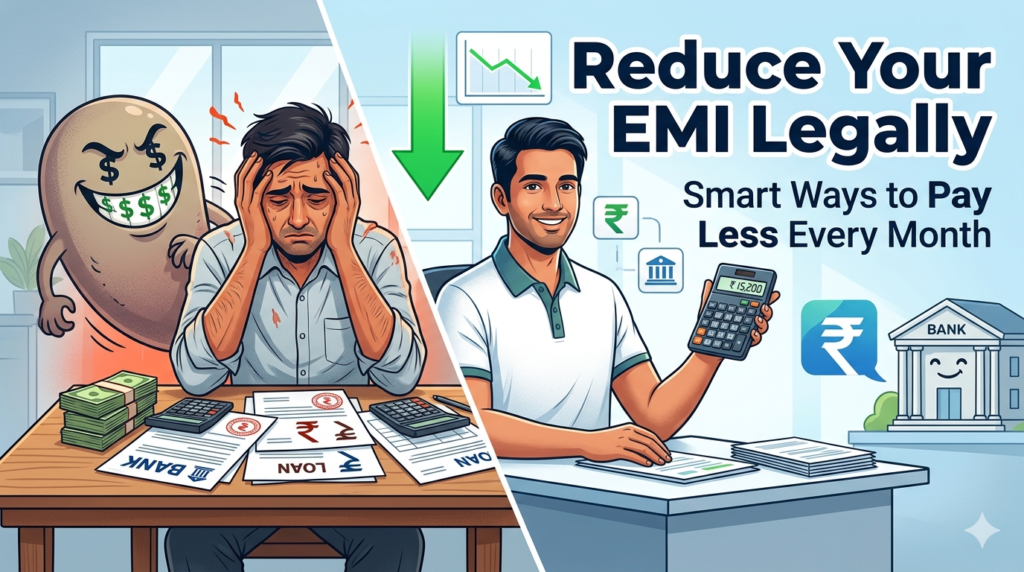
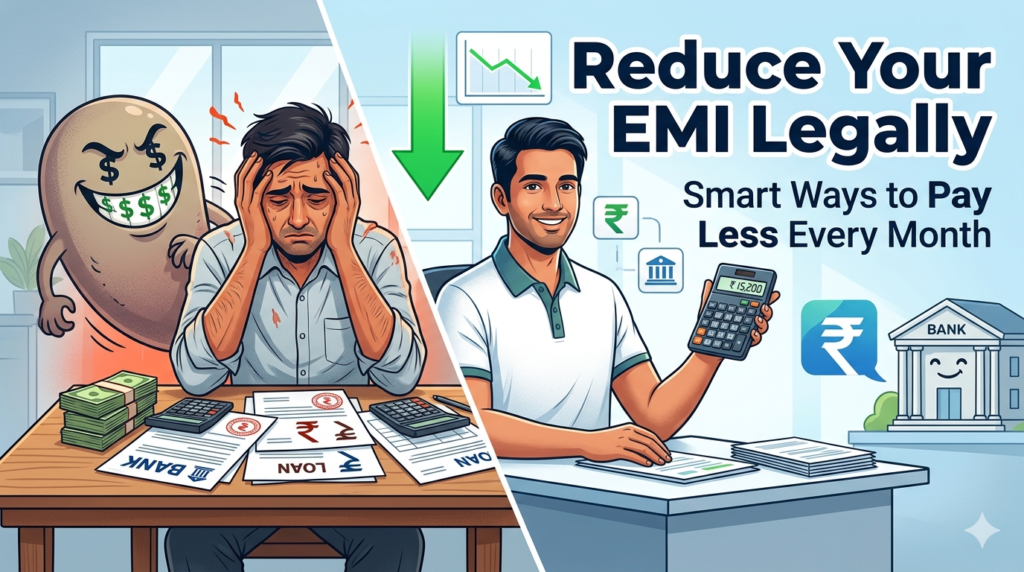
How to Reduce Your Loan EMI Legally — Without Running Away to the Himalayas
Every month, on a day that’s circled in red on your mental calendar, your bank account sends you a quiet, heartfelt message: “Goodbye.” That deduction — ruthless, punctual, almost cheerful in its regularity — is your EMI. Equated Monthly Installment. Or, as most Indians privately call it, Emotional Monthly Injury.
Whether it’s a home loan haunting you for 20 years, a car loan reminding you that you could’ve just taken the metro, or a personal loan that funded a wedding nobody will remember in five years — the EMI is a permanent resident in your monthly budget, paying no rent and causing maximum damage.
But here’s the good news your bank won’t put on a billboard: you have more power over your EMI than you think. There are entirely legal, RBI-approved, financially sound ways to bring that number down — and this guide will walk you through every single one of them. No jugaad. No fraud. No running away.
What Is an EMI — And Why It Feels Like a Monthly Heart Attack
An EMI is the fixed monthly amount you pay to repay a loan over a defined period. It has two components: principal (the actual money you borrowed) and interest (the bank’s way of saying “thank you for choosing us, now pay us more”).
Here’s the cruel mathematics of it: in the early years of a long-tenure loan, almost 70–80% of your EMI goes toward interest. You’re essentially paying rent on money you’ve already spent. The principal barely moves. Banks call this “front-loaded interest repayment.” You can call it whatever you like — just not in public.
The EMI formula itself is elegant in a sadistic sort of way:
Where P = Principal loan amount, R = Monthly interest rate (annual rate ÷ 12), N = Loan tenure in months.
Translation: the bigger the loan, the longer the tenure, and the higher the rate — the heavier your heart (and wallet).
So what can you actually pull on this formula? Three things: reduce P, reduce R, or reduce N strategically. Everything in this article traces back to one of those three levers. Let’s work through them.
Legal Ways to Reduce Your EMI
1. Refinance Your Loan — Politely Tell Your Bank You’ve Found Someone Better
Loan refinancing means replacing your existing loan with a new one — usually at a lower interest rate, better terms, or both. Think of it as a divorce from your current lender, except you walk away with better finances instead of contested furniture.
This works especially well if:
- Interest rates in the market have dropped since you took your loan.
- Your credit score has improved significantly.
- You originally took the loan during a high-rate regime.
How to do it: Approach your existing bank first. Sometimes, just mentioning that you’re “exploring better options” is enough to make them suddenly discover a lower rate they’d been sitting on. If they don’t budge, apply to another lender. Most banks and NBFCs offer refinancing for home loans, personal loans, and car loans.
2. Balance Transfer — The Art of Ghosting Your Bank (Legally)
A balance transfer is essentially refinancing with a new lender. You move your outstanding loan balance to a bank or NBFC offering a lower interest rate. It’s particularly popular for home loans in India, where even a 0.5% rate difference on a ₹50 lakh loan over 20 years can save you ₹5–7 lakh in total interest.
The process is straightforward:
- Get a statement of your outstanding principal from your current lender.
- Apply for a balance transfer with the new lender.
- The new lender pays off your existing bank and creates a fresh loan account at the lower rate.
- You now pay the new, lower EMI — and quietly enjoy the savings.
Best candidates for balance transfer: borrowers in the first half of their loan tenure (since most interest is front-loaded), those with high credit scores (750+), and those with outstanding balances large enough to justify transfer costs.
| Parameter | Before Transfer | After Transfer |
|---|---|---|
| Outstanding Loan | ₹40,00,000 | ₹40,00,000 |
| Interest Rate | 9.5% | 8.5% |
| Remaining Tenure | 15 years | 15 years |
| Monthly EMI | ₹41,783 | ₹39,387 |
| EMI Saved Per Month | ₹2,396 saved every month → ₹4.31 lakh over 15 years | |
3. Increase Your Loan Tenure — Spread the Pain, Reduce the Monthly Bleed
If your primary goal is to reduce the monthly EMI amount right now (perhaps because your income has taken a hit or your expenses have increased), extending the loan tenure is a legitimate, widely-used option.
A home loan of ₹30 lakh at 9% for 10 years carries an EMI of approximately ₹38,000. Extend it to 20 years, and the EMI drops to around ₹27,000. That’s ₹11,000 back in your pocket every month.
The caveat: You pay significantly more total interest over the longer period. This strategy is best used as a cash flow management tool — lower your EMI now, and when your income improves, use prepayments aggressively to close the loan faster. More on that in the next section.
4. Prepayment Strategies — Attacking the Loan Before It Attacks You
This is arguably the most powerful, underused tool in an Indian borrower’s arsenal. Prepayment means making lump-sum payments toward your principal over and above your regular EMI. And thanks to RBI guidelines, prepayment on floating-rate loans is completely free — no penalties, no charges.
Why does prepayment work so dramatically? Because every rupee of principal you reduce today means you’re no longer paying interest on it for the remaining tenure. It’s like cutting off the enemy’s supply line.
Prepayment approaches that work:
- Annual bonus strategy: Direct your entire annual bonus or incentive toward loan prepayment. Even ₹1–2 lakh/year in prepayments on a home loan can cut 4–5 years off your tenure.
- EMI increase strategy: Increase your EMI amount by even 5–10% each year as your income grows. This alone can shorten a 20-year loan to 14–15 years.
- Step-up prepayment: Start small and increase prepayments as your income rises. This aligns with most Indians’ salary growth trajectory.
5. Negotiate With Your Lender — Your Bank Is Not Your Friend, But It Can Be
Here’s something the average Indian borrower doesn’t realize: you can negotiate with your bank. Not at the counter, not through an app, but with a well-worded letter or a meeting with the branch manager or relationship manager.
Situations where negotiation works:
- You’ve been a loyal customer with a spotless repayment record for 3+ years.
- Your credit score has significantly improved since the loan was sanctioned.
- You’re a high-value customer (salary account, FDs, investments all with the same bank).
- Market rates have dropped but your loan rate hasn’t been revised (common with older fixed-rate loans).
Banks would rather reduce your rate by 0.25–0.5% than lose you entirely to a competitor via balance transfer. Frame it that way. Politely. With documentation.
6. Switch From Fixed to Floating Rate (or Vice Versa)
Fixed-rate loans offer EMI predictability but are typically 1.5–2.5% higher than floating rates. If you took a fixed-rate loan during a high-rate environment, switching to a floating rate when rates drop can noticeably reduce your EMI.
Conversely, if you’re on a floating rate and rates are rising (as they did sharply during 2022–23 in India), switching to a fixed rate locks in your current rate and protects your EMI from further increases.
The switch typically involves a conversion fee of 0.5–1% of outstanding principal — but for large loans over long tenures, this cost is usually recovered within 12–18 months of the rate differential.
7. Use Windfalls Smartly — Resist the Urge to Buy a New TV
Income tax refunds, maturity proceeds from FDs, LIC policies, stock sales, inheritance, freelance income, gifts — these windfalls are golden opportunities to attack your loan principal.
The average Indian’s instinct on receiving a windfall is to either (a) put it in a savings account earning 3.5% or (b) upgrade the home theater. Meanwhile, a loan is charging 9–11% interest. The math is not in your favor.
7 Strategies at a Glance
Refinancing
Replace your loan with a new one at lower rates. Best for large outstanding amounts.
Balance Transfer
Move your loan to a lender with lower rates. Free for floating-rate home loans.
Extend Tenure
Lower your EMI by spreading repayment. Trade-off: more total interest paid.
Prepayment
Reduce principal aggressively. Powerful, free on floating-rate loans.
Negotiate Rate
Leverage your creditworthiness and loyalty to get a rate reduction.
Rate Switch
Convert fixed ↔ floating based on the rate environment. Pay a small fee, save more.
Real-Life Scenario: Rajesh’s Loan Liberation Story
Rajesh, a 38-year-old software engineer in Pune, took a home loan of ₹60 lakh at 9.8% in 2019 for 25 years. His EMI: ₹53,500/month. By 2023, his outstanding balance was ₹56 lakh — barely moved.
Here’s what Rajesh did:
Step 1 — Balance Transfer: He moved his loan to a new bank at 8.6%, reducing his EMI to ₹49,200. Saved ₹4,300/month.
Step 2 — Annual Prepayments: He directed his ₹2.5 lakh annual bonus entirely to prepayment for 3 consecutive years.
Step 3 — EMI Step-Up: After a promotion, he increased his EMI by ₹5,000/month.
Result: His 25-year loan is now projected to close in under 16 years, saving him an estimated ₹18–20 lakh in total interest.
Loan Tenure Cut by 9 Years ₹18–20 Lakh Interest Saved EMI Reduced by ₹4,300/moCommon Mistakes to Avoid (That Banks Quietly Love)
- Ignoring the loan amortisation schedule: Most borrowers never look at it. They should. It tells you exactly how much interest you’re paying each month and when your principal finally starts moving.
- Confusing lower EMI with lower cost: Extending your tenure lowers EMI but increases total cost. Always calculate total interest outflow, not just monthly payment.
- Skipping the fine print on balance transfers: Processing fees, legal charges, technical valuation fees — these can add up to 1–2% of the loan amount. Always model the total cost.
- Not checking your CIBIL score before applying: A score below 700 will get you rejected or offered a higher rate. Check and fix your score first.
- Prepaying toward the end of tenure: Front-loaded interest means late prepayments have minimal impact. If you’re in the last 5 years of a loan, the principal-to-interest ratio has flipped — your payments are mostly principal anyway.
- Taking a top-up loan to prepay another loan: This is robbing Peter to pay Paul. Unless the rate differential is dramatic and the math clearly works, avoid this trap.
Expert Tips From Financial Advisors
- Review your loan every 12–18 months. Interest rate environments change. A loan that was competitive in 2021 may now be 1–1.5% above market. Set a calendar reminder.
- Prioritise loans by interest rate, not size. Pay off your highest-rate loan (personal loan, credit card loan) first — always. A 22% personal loan is a financial emergency disguised as a loan.
- For home loans specifically, always opt for the “reduce tenure” option over “reduce EMI” when making prepayments — unless you genuinely need the cash flow relief. You save far more interest by closing the loan early.
- Maintain a credit score above 750. This is your single biggest leverage point. Banks routinely offer 0.25–0.5% lower rates to high-CIBIL borrowers. Over 20 years on a ₹50 lakh loan, that’s ₹3–5 lakh in savings.
- Get everything in writing. If your bank verbally agrees to a rate reduction or waiver, follow up with an email and ask for written confirmation. Banks have short memories when it benefits them.
- Compare total cost, not just rate. A loan at 8.5% with high processing fees may cost more than a 8.7% loan with zero fees over your tenure. Use an online EMI calculator with a total interest view.
Frequently Asked Questions (FAQs)

blogger for past 15 years onprasadgovenkar.com
https://www.linkedin.com/in/prasadgovenkar/
https://www.facebook.com/prasad.govenkar