2026 Guide
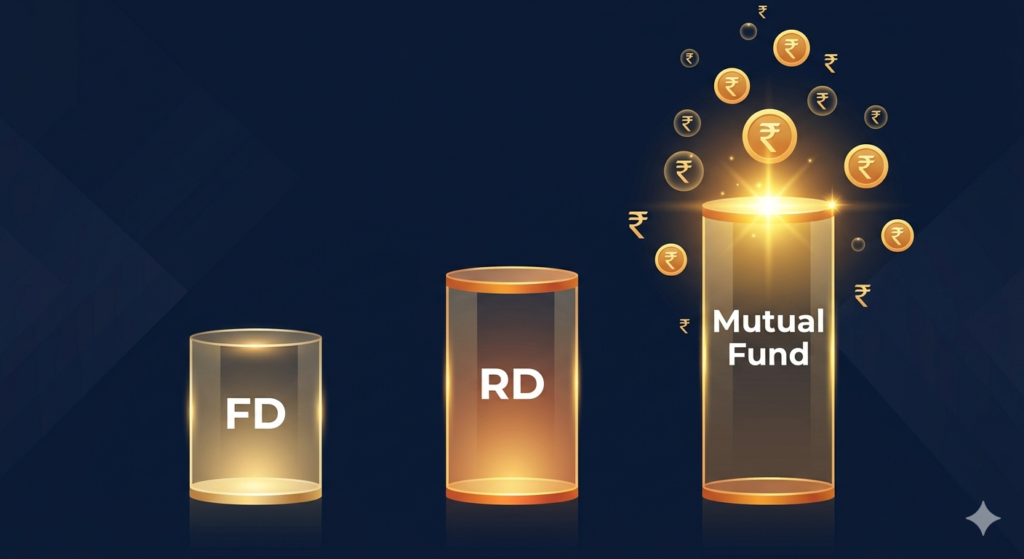
FD vs RD vs Mutual Fund Returns (2026 Guide) – Which Investment Actually Wins?
📋 Table of Contents
- Introduction – The Great Indian Investment Dilemma
- What is a Fixed Deposit (FD)?
- What is a Recurring Deposit (RD)?
- What is a Mutual Fund?
- Detailed Comparison: Returns, Risk, Liquidity & Taxation
- Quick Summary Table
- ₹1 Lakh Investment Example (Real Calculations)
- Who Should Choose What?
- Common Mistakes Investors Make
- Common Myths About FD, RD & Mutual Funds
- Best Investment Strategy for 2026
- Pro Tips for Maximising Returns
- Conclusion – Actionable Advice
- FAQ Section
1. Introduction – The Great Indian Investment Dilemma
Picture this: You have just received your annual bonus of ₹1 lakh. Your parents are telling you to put it in a Fixed Deposit because “it is safe.” Your friend is insisting on a Mutual Fund SIP because “the market is booming.” Your colleague at work quietly mentions an RD so you don’t feel the pinch each month. And you are sitting in the middle, completely confused.
This is the daily reality for millions of Indian investors in 2026. With interest rates fluctuating, inflation eating into returns, and hundreds of financial products competing for your attention, choosing between FD vs RD vs Mutual Funds has never felt more challenging.
This guide is designed to cut through all the noise. We will compare all three instruments across every factor that matters — real returns, risk, liquidity, taxation, and inflation-adjusted performance — and show you exactly which option makes the most sense based on your unique financial situation.
Before we dive in, note that as per Reserve Bank of India (RBI) data and AMFI India reports, the mutual fund industry in India crossed ₹50 lakh crore in AUM in 2025, which speaks to the growing trust in market-linked instruments alongside traditional options. Also read our post on Best Investment Options in India for 2026 for a broader overview.
2. What is a Fixed Deposit (FD)?
A Fixed Deposit is one of the oldest and most trusted savings instruments in India. You deposit a lump-sum amount with a bank or Non-Banking Financial Company (NBFC) for a fixed period — ranging from 7 days to 10 years — and earn a predetermined interest rate.
How FD Works
- You invest a one-time lump sum amount.
- The bank locks it in for the chosen tenure (e.g., 1 year, 3 years, 5 years).
- Interest is credited monthly, quarterly, or at maturity depending on the payout option.
- At the end of the tenure, you get back your principal plus interest.
FD Interest Rates in 2026
As of 2026, major Indian banks are offering FD rates in the range of 6.5% to 7.5% per annum for general citizens, with an additional 0.25% to 0.50% for senior citizens. Small Finance Banks like AU Small Finance Bank and Unity Small Finance Bank offer up to 8.0% to 9.0%, though these come with higher risk.
Key Features of FD
- Minimum investment: As low as ₹1,000 in most banks
- Guaranteed returns: Rate is fixed at the time of deposit
- Premature withdrawal: Allowed with a small penalty (usually 0.5–1%)
- Loan against FD: You can take a loan up to 90% of FD value
- DICGC insurance: Deposits up to ₹5 lakh are insured by the Deposit Insurance and Credit Guarantee Corporation (DICGC)
3. What is a Recurring Deposit (RD)?
A Recurring Deposit is essentially a disciplined savings tool where you deposit a fixed amount every month for a chosen tenure and earn interest comparable to an FD. It is ideal for salaried individuals who want to invest systematically from their monthly income without committing a large lump sum upfront.
How RD Works
- You choose a fixed monthly instalment — say ₹5,000 per month.
- You select a tenure — typically 6 months to 10 years.
- Interest is compounded quarterly (in most banks).
- At maturity, you receive the total deposits plus accumulated interest.
RD Interest Rates in 2026
RD interest rates in 2026 are closely aligned with FD rates — ranging from 6.5% to 7.25% per annum for general citizens across major public and private sector banks. Post Office RDs offer 6.7% per annum, making them a government-backed option worth considering.
Key Features of RD
- Monthly commitment: Minimum ₹100 per month in Post Office; varies by bank
- Discipline builder: Automatic monthly deduction encourages saving
- Premature closure: Allowed, usually with a penalty
- Suitable for: First-time investors and salaried professionals
4. What is a Mutual Fund?
A Mutual Fund is a professionally managed investment vehicle that pools money from multiple investors and invests it in a diversified portfolio of stocks, bonds, gold, or a combination thereof. Regulated by SEBI (Securities and Exchange Board of India), mutual funds offer a wide spectrum of options to suit every type of investor.
Types of Mutual Funds
🔵 Equity Mutual Funds
These funds invest primarily in stocks. They carry the highest risk but have historically delivered the highest returns — averaging 12%–18% CAGR over 5–10 years. Examples include Large Cap Funds, Mid Cap Funds, ELSS (Tax-Saving Funds), and Flexi Cap Funds.
🟢 Debt Mutual Funds
These funds invest in government securities, corporate bonds, and money market instruments. They carry lower risk and offer returns of 6%–8% per annum, making them a step above FD in return potential with slightly higher risk.
🟡 Hybrid Mutual Funds
Hybrid funds invest in both equity and debt, offering a balanced risk-return profile. Aggressive Hybrid Funds typically have a 65–80% equity allocation, while Conservative Hybrid Funds are tilted toward debt.
🔴 Index Funds and ETFs
These passively track an index like Nifty 50 or Sensex and have very low expense ratios. They have grown enormously popular in India since 2022 due to their simplicity and low cost. See our detailed guide on Index Funds vs Active Funds in India.
5. Detailed Comparison: Returns, Risk, Liquidity & Taxation
5.1 Returns Comparison
Fixed Deposits offer guaranteed returns of around 6.5%–7.5% per year in 2026. These are predictable and safe, but they are the lowest among the three options on a pre-tax, real-return basis.
Recurring Deposits offer similar returns to FDs — approximately 6.5%–7.25% per year — but the effective yield is lower than FD because deposits are made monthly, not as a lump sum, meaning the interest compounds on a progressively growing principal.
Mutual Funds — particularly equity mutual funds — have historically delivered 12%–15% CAGR over 5–10 year periods, based on data from AMFI India. Debt funds deliver 6%–8%, and hybrid funds fall in the 9%–12% range. However, returns are not guaranteed and are subject to market risk.
5.2 Risk Comparison
- FD: Near-zero risk. Principal and interest are guaranteed. DICGC insures up to ₹5 lakh.
- RD: Same as FD — near-zero risk. Returns are fixed from Day 1.
- Mutual Funds: Varies significantly. Debt funds carry low-to-moderate risk; equity funds can be volatile in the short term. Over long periods (7–10 years), equity funds have rarely generated negative returns on Nifty 50-linked portfolios.
5.3 Liquidity Comparison
- FD: Moderate liquidity. Premature withdrawal is possible but attracts a penalty of 0.5%–1%. A loan against FD is available instantly.
- RD: Low liquidity. Premature closure often requires a waiting period and attracts a penalty. Monthly missed payments can attract fines.
- Mutual Funds: High liquidity. Most open-ended mutual funds can be redeemed within 1–3 working days. ELSS has a 3-year lock-in. Liquid and overnight funds can be redeemed same-day.
5.4 Taxation
FD Taxation: Interest earned on FDs is fully taxable as per your income tax slab. If interest exceeds ₹40,000 per year (₹50,000 for senior citizens), TDS at 10% is deducted. For someone in the 30% tax bracket, the post-tax FD return drops to around 4.5%–5.25%, which is below inflation.
RD Taxation: Same as FD. Interest is taxable as per slab, and TDS applies. There is no tax advantage in an RD.
Mutual Fund Taxation (as of FY 2025–26):
- Equity Funds (held >1 year): Long Term Capital Gains (LTCG) above ₹1.25 lakh per year taxed at 12.5% (as per Budget 2024).
- Equity Funds (held <1 year): Short Term Capital Gains (STCG) taxed at 20%.
- Debt Funds: Gains taxed as per your income tax slab regardless of holding period (after the March 2023 amendment).
- ELSS Funds: Investment up to ₹1.5 lakh per year qualifies for deduction under Section 80C (if opting for the old tax regime).
5.5 Inflation Impact
India’s Consumer Price Index (CPI) inflation has averaged 5%–6% per year over the last decade. When you earn 7% on an FD and pay 30% tax on interest, your post-tax return is roughly 4.9%. After subtracting 5.5% inflation, your real return is -0.6% — meaning you are actually losing purchasing power.
Equity mutual funds, with historical returns of 12%–15%, comfortably beat inflation over the long term, generating positive real returns of 6%–9%.
6. Quick Summary Table
| Parameter | Fixed Deposit (FD) | Recurring Deposit (RD) | Mutual Fund (Equity) |
|---|---|---|---|
| Investment Type | Lump Sum | Monthly Instalments | Lump Sum or SIP |
| Returns (2026) | 6.5% – 7.5% p.a. | 6.5% – 7.25% p.a. | 12% – 15% p.a. (historical) |
| Returns Guaranteed? | Yes | Yes | No (Market-linked) |
| Risk Level | Very Low | Very Low | Moderate to High |
| Liquidity | Moderate | Low | High (except ELSS) |
| Taxation | As per slab (unfavourable) | As per slab (unfavourable) | LTCG @ 12.5% (favourable) |
| Beats Inflation? | Rarely (post-tax) | Rarely (post-tax) | Yes (long term) |
| Minimum Investment | ₹1,000 (lump sum) | ₹100/month | ₹500/month (SIP) |
| Lock-in Period | None (5 yr for 80C) | None (but penalty on early exit) | None (3 yr for ELSS) |
| Suitable For | Conservative, short-term goals | Salaried, disciplined savers | Long-term wealth creation |
| Regulatory Body | RBI | RBI | SEBI / AMFI |
7. ₹1 Lakh Investment Example – Real Calculations
Let us make this very practical. Suppose you invest ₹1,00,000 today and hold it for 5 years. Here is how your money grows across all three options:
Assumptions Used
- FD Rate: 7.0% per annum (compounded quarterly)
- RD: ₹8,333/month for 12 months = ~₹1 lakh, then held; for simplicity, compared as lump sum equivalent at 6.8%
- Equity Mutual Fund: 12% CAGR (historical average, not guaranteed)
- Tax Bracket: 30% for FD/RD interest; LTCG 12.5% on MF gains above ₹1.25 lakh
- Inflation: 5.5% per year
📊 The Bottom Line of the ₹1 Lakh Comparison
After 5 years, your ₹1 lakh could become:
- FD: ~₹1,28,433 (post-tax) — real return after inflation: nearly flat
- RD: ~₹1,26,500 (post-tax) — similar to FD
- Equity Mutual Fund: ~₹1,70,484 (post-tax at 12% CAGR) — clear winner for long-term goals
⚠️ Mutual fund return of 12% CAGR is a historical average and is not guaranteed. Past performance does not guarantee future results.
For a more detailed year-by-year SIP vs lump sum analysis, visit our guide on SIP vs Lump Sum – Which is Better?
8. Who Should Choose What?
- A retiree or senior citizen needing regular income
- Saving for a goal within 1–2 years (house down payment, vacation)
- In a low tax bracket (0%–5%) where FD tax impact is minimal
- Risk-averse and cannot afford to lose any principal
- Looking to build an emergency fund
- A salaried person wanting to save a fixed amount monthly
- Saving for a specific short-term goal in 1–3 years
- New to investing and want a simple, disciplined approach
- Not ready to take any market-linked risk
- Building a habit of regular saving
- Investing for long-term goals (5+ years) like retirement or children’s education
- In the 20%–30% tax bracket (tax efficiency of LTCG is very valuable)
- Willing to accept short-term volatility for higher long-term gains
- Looking to beat inflation meaningfully
- Starting a SIP with a monthly surplus of ₹500 or more
Also see our article on Investment Guide for Salaried Employees in India for a personalised breakdown.
9. Common Mistakes Investors Make
- Ignoring post-tax returns: Most investors compare FD rates and mutual fund returns without adjusting for tax. Always calculate post-tax returns for an accurate comparison.
- Putting all money in FDs “because they are safe”: Safety of principal does not mean your wealth is growing. If FD returns do not beat inflation after tax, you are effectively losing money.
- Stopping SIPs when the market falls: Market corrections are buying opportunities. Stopping your SIP during a downturn is one of the most common — and costly — mistakes in mutual fund investing.
- Not matching investment to goal: Using an FD for a 20-year retirement corpus, or using equity mutual funds for a 6-month goal, is a mismatch of instrument to objective.
- Ignoring the expense ratio: In mutual funds, a 1% difference in expense ratio can mean lakhs of rupees over 20 years due to compounding. Prefer Direct Plans over Regular Plans to save on commissions.
- Breaking RDs prematurely: Premature closure attracts penalties and ruins the compounding effect. Only start an RD for an amount you can commit to every month.
- Not diversifying: Relying on just one of these three instruments is a missed opportunity. A smart strategy uses a combination of all three based on your goals.
10. Common Myths About FD, RD & Mutual Funds
Fact: Mutual funds are regulated by SEBI and managed by professional fund managers. While short-term volatility exists, diversified equity funds have never given negative returns over any 10-year period on the Nifty 50. Gambling has no underlying value; equity investments represent real business ownership.
Fact: FDs in cooperative banks and NBFCs carry default risk. Remember the PMC Bank and DHFL crises. DICGC covers only ₹5 lakh per depositor per bank. Always check the bank’s financial health before making large FD investments.
Fact: Both involve monthly contributions, but that is where similarity ends. RD offers fixed, guaranteed returns; SIP in equity mutual funds offers market-linked returns that can be far higher over the long term.
Fact: You can start a SIP with just ₹100–₹500 per month in many AMCs. Many top-performing large-cap funds accept ₹500/month SIPs.
Fact: Small finance banks and cooperative banks often offer higher rates but carry higher credit risk. A 9% rate from an unstable institution is far less attractive than 7% from a nationalised bank when risk is factored in.
11. Best Investment Strategy for 2026
The smartest investors in 2026 are not choosing between FD, RD, and Mutual Funds. They are using all three strategically:
The 50–30–20 Framework for 2026
| Allocation | Instrument | Purpose |
|---|---|---|
| 20% | FD / RD | Emergency fund + short-term goals (1–2 years) |
| 30% | Debt Mutual Funds / Hybrid Funds | Medium-term goals (3–5 years) with moderate growth |
| 50% | Equity Mutual Funds (SIP) | Long-term wealth creation (7–20 years) |
Adjust equity allocation based on age: Equity % = 100 – your age is a simple thumb rule. A 30-year-old can afford 70% equity; a 60-year-old should keep equity exposure below 40%.
For tax-saving, consider adding ELSS mutual funds (under Section 80C) to your portfolio, as they combine tax benefits with long-term wealth creation — a feature FDs and RDs do not offer together. Read more in our ELSS vs PPF vs NPS Comparison.
12. Pro Tips for Maximising Returns
- Use the FD laddering strategy: Instead of one large FD, split it into multiple FDs with different maturities (1 year, 2 years, 3 years). This gives liquidity at regular intervals and protects against interest rate changes.
- Choose Direct Plans for mutual funds: Direct Plans have no distributor commission, so expense ratios are 0.5%–1% lower. Over 20 years, this can mean 20%–30% more corpus.
- Use ELSS for dual benefit: ELSS gives up to ₹46,800 in annual tax savings (30% bracket) and builds equity wealth simultaneously — with the shortest lock-in of 3 years among all 80C options.
- Step-up your SIP every year: Increase your SIP amount by 10%–15% annually to match salary growth. This significantly accelerates long-term wealth creation.
- Avoid FD renewals on auto-pilot: Many banks auto-renew FDs at prevailing rates, which may be lower. Review your FD at maturity and explore better alternatives.
- Keep an eye on inflation-indexed instruments: RBI’s Inflation-Indexed Bonds (IIBs), when available, can offer better inflation protection than standard FDs.
- Diversify across fund categories: Do not put all equity money in one fund or one AMC. Spread across 3–4 well-rated funds from different fund houses.
13. Conclusion – Actionable Advice for 2026
The debate of FD vs RD vs Mutual Fund returns does not have one universal winner — it has a context-dependent winner. Here is the final verdict:
- If you need guaranteed, risk-free returns for the short term: FD is your friend.
- If you are a salaried individual building savings discipline: RD works well for you.
- If you want to build real, inflation-beating wealth over 5–10+ years: Equity Mutual Funds are the clear winner.
The biggest mistake is treating these as competing options. A financially literate investor uses FD for emergency funds, RD for goal-specific monthly savings, and Mutual Funds as the primary engine of long-term wealth creation.
Start your mutual fund journey today through SEBI-registered platforms. You can also track your portfolio’s performance relative to benchmarks using tools provided by AMFI India and read further on The Economic Times Mutual Fund Section for the latest market updates.
Finally, always consult a SEBI-registered financial advisor before making major investment decisions. Also explore our Beginner’s Guide to Investing in India if you are just starting out.
Share it with your family and friends on WhatsApp — help them invest smarter in 2026!
Share on WhatsApp 🟢
14. Frequently Asked Questions (FAQ)

Prasad Govenkar is an experienced enterprise architect with over 24 years of industry expertise, specializing in telecom BSS solutions and large-scale technology transformations. Alongside his professional career in the technology domain, he has developed a strong passion for personal finance, investing, and wealth
Through InvestIndia.blog, Prasad shares practical, easy-to-understand insights to help individuals take control of their financial future. His approach combines analytical thinking from his engineering background with real-world investing experience, making complex financial concepts simple and actionable.