
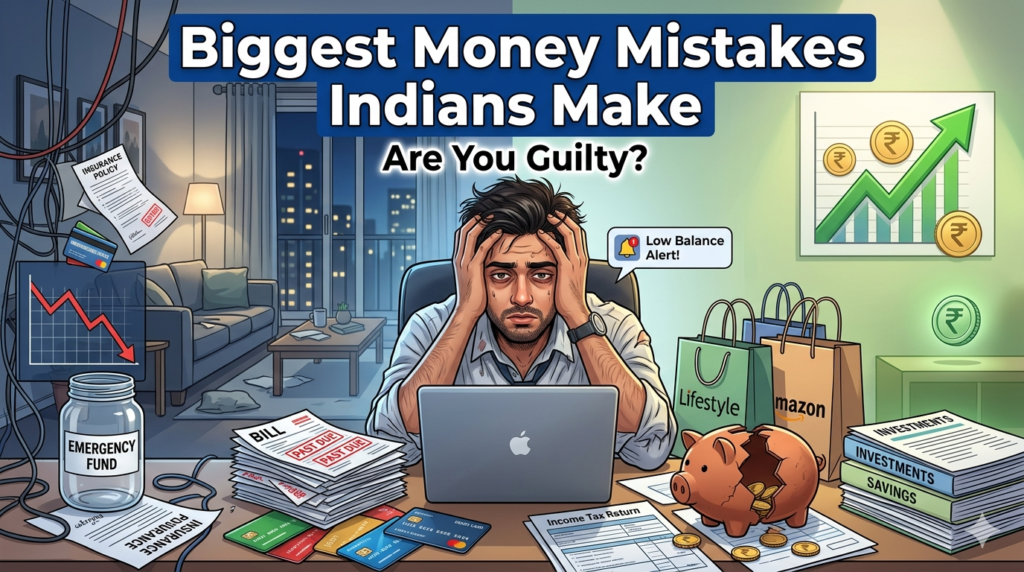
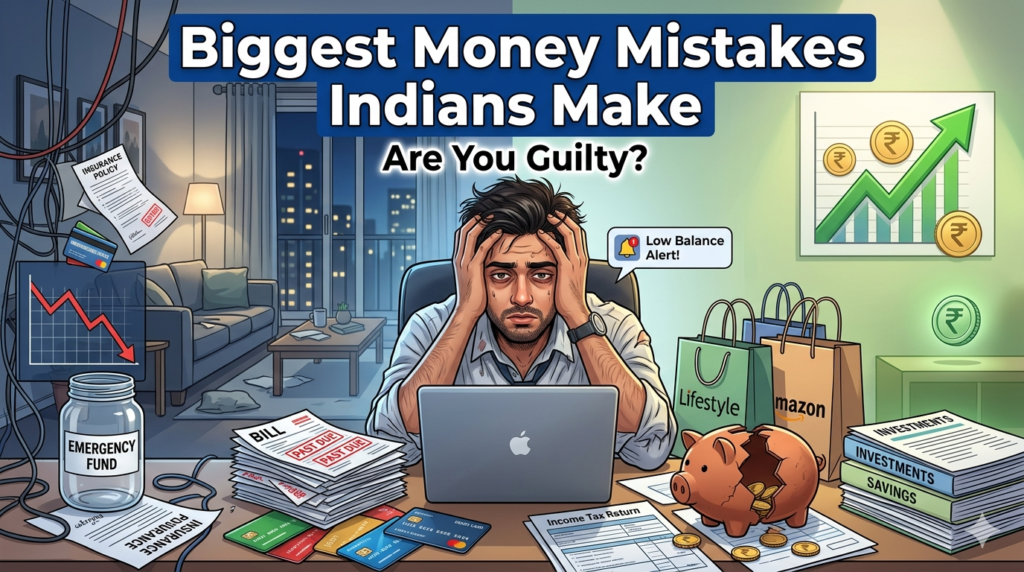
Biggest Money Mistakes Salaried Employees Make in India
The painfully honest guide your HR department will never give you
Ravi earns ₹1.4 lakh a month. He drives a car on EMI, lives in a rented flat, uses three credit cards, has a LIC policy he barely understands, and has exactly ₹18,000 in savings. He is 34. He is not alone. He might be you.
Every month, millions of Indian salaried professionals receive a salary credit notification — that brief, beautiful moment before the EMIs, rent, and Swiggy orders eat it alive. We earn more than any previous generation. We spend more. We save less. And somewhere between our career ambitions and our Netflix subscriptions, we make the same financial mistakes, year after year.
This article isn’t about judging your oat milk latte habit. It’s about the structural money mistakes that are silently destroying the financial futures of salaried employees across India — and exactly what you should do instead. Consider this your financial mirror. It won’t always be flattering.
Let’s dive into the biggest money mistakes salaried employees India must stop making in 2026.
📎 You Might Also Like
Living Paycheck to Paycheck — At Every Salary Level
Here’s a phenomenon that defies logic: the more people earn, the more they spend. A ₹40,000/month fresher is broke. A ₹1.5 lakh/month senior manager is also broke. A ₹3 lakh/month VP? Somehow still broke. This isn’t coincidence — it’s called lifestyle inflation, and it’s India’s most democratic financial disease.
When you got your first hike, you upgraded your phone. Second hike? New car. Third hike? Bigger flat. Each upgrade felt justified. The problem is your wealth didn’t grow — only your expenses did.
According to a 2025 survey by the Reserve Bank of India, household financial savings as a percentage of GDP dropped to a multi-decade low. Urban salaried professionals are among the lowest savers relative to income.
Fix it: Automate savings before you can spend them. On salary day, move a minimum of 20% to a separate account — before you pay anyone else. Pay yourself first. This one habit alone separates the financially secure from the perpetually anxious.
Having Zero Emergency Fund (Or Calling a Credit Card One)
In February 2026, when Priya’s father was hospitalized unexpectedly, she didn’t have a problem — she had a credit card. She swiped ₹2.8 lakh, couldn’t pay it back in full, and is now paying 42% annualized interest. Her “emergency fund” became a debt trap.
Most financial planners recommend keeping 3–6 months of expenses in a liquid, accessible account. Most salaried Indians have zero. The reason? “I’ll start next month.” The next month never comes.
A medical emergency, job loss, or car breakdown shouldn’t threaten your financial stability. If it does, you don’t have a savings problem — you have a system problem. Your finances have no shock absorbers.
Fix it: Start small. Even ₹5,000/month into a high-yield liquid mutual fund or a savings account earning 6–7% builds ₹60,000 in a year. Park your emergency fund in a SEBI-regulated liquid fund — not a regular savings account with 2.7% interest.
The Credit Card Illusion: “I’ll Pay It Next Month”
Credit cards are brilliant financial tools — for the bank. For you, they’re a loan disguised as a reward program. The average credit card interest rate in India in 2026 sits between 36–48% per annum. That’s not a typo. Forty-eight percent.
And yet, salaried professionals routinely carry balances, pay only the minimum due (which barely covers interest), and congratulate themselves for earning 2% cashback on purchases that cost them 40% in interest. The math is brutal.
Outstanding credit card debt in India as of early 2026 — a record high, per RBI data. A significant chunk belongs to salaried urban professionals who “just needed to manage cash flow.”
Fix it: Use credit cards only for planned expenses you can pay in full by the due date. Set up auto-pay for the full outstanding amount. If you’re carrying a balance today, treat it as a financial emergency and prioritize eliminating it before any new investment.
Treating LIC as an Investment (The Policy Trap)
Uncle Ramesh told you: “Beta, LIC lelo — it’s safe, it’s guaranteed, and your family is protected.” So you took a ₹50,000/year endowment policy at 28. At 50, you’ll receive ₹15 lakh maturity value. Sounds good?
Run the numbers. ₹50,000 per year for 22 years = ₹11 lakh invested. You receive ₹15 lakh. That’s roughly 2.5% annualized return. Inflation in India runs 5–6%. In real terms, you lost money — and you called it a safe investment.
Insurance and investment are two different tools that should never be mixed. Traditional LIC policies are neither good insurance (low coverage) nor good investments (abysmal returns). They exist in a confusing middle ground that benefits primarily the insurer.
Fix it: Buy a pure term insurance plan — ₹1 crore cover for a healthy 30-year-old costs as little as ₹10,000–12,000/year. Invest the remaining ₹38,000 in equity mutual funds via SIP. In 22 years, that corpus could be ₹3–4 crore at a 12% CAGR — not ₹15 lakh.
If you already have an LIC endowment policy, don’t panic. Check the surrender value, compare it to continuing, and consult a SEBI-registered fee-only financial planner before making a decision. Don’t let sunk cost keep you in a bad product.
Ignoring Term & Health Insurance Until It’s Too Late
Here’s a dark truth: the best time to buy health insurance was five years ago. The second-best time is today. Salaried employees often assume their employer’s group health cover is sufficient. It rarely is — ₹3–5 lakh cover sounds like a lot until a single hospitalization in a tier-1 city costs ₹6–8 lakh.
When you leave a job, that cover vanishes. If you’re between jobs during a medical emergency, your bank account is the only insurance you have.
Fix it: Get a personal health insurance policy with at least ₹10–15 lakh coverage, independent of your employer. For families, a family floater with a super top-up is both adequate and affordable. Buy young — premiums are dramatically lower at 28 than at 38.
The FD Obsession: Playing It “Safe” Into Poverty
Fixed Deposits are the financial equivalent of a comfort blanket. They feel safe, your parents trusted them, and the bank gives you a nice certificate. The problem? Post-tax FD returns in 2026 sit around 5–5.5% for most tax brackets. Inflation is running at 5–6%. You’re essentially treading water — or slowly sinking.
If you invest ₹1 lakh in an FD at 6.5% for 20 years, you get ~₹3.5 lakh. The same ₹1 lakh in an equity index fund at 12% CAGR becomes ~₹9.6 lakh. That difference — ₹6 lakh — is the cost of choosing “safety” over sense.
Fix it: FDs are great for your emergency fund and short-term goals (1–3 years). For goals beyond 5 years, equity mutual funds — specifically diversified index funds tracking Nifty 50 or Nifty Next 50 — are historically far superior. SEBI’s mutual fund regulations have made these vehicles safer and more transparent than ever.
Tax Planning in March: The Last-Minute Panic
Every year, millions of salaried Indians frantically buy insurance policies, dump money into PPF, and make random investments in February–March — purely to save tax. This is reactive, inefficient, and often locks money into poor products.
Under the new tax regime (which is now the default for FY 2025–26), most standard deductions no longer apply. Yet many employees haven’t even compared the old vs. new regime to determine which benefits them more.
In 2026, the new tax regime offers a ₹75,000 standard deduction. If your deductions (80C, HRA, home loan, NPS) exceed ~₹2.5–3 lakh, the old regime may still benefit you. Run the numbers in April — not March. The Income Tax Department’s official calculator is free and takes 10 minutes.
Fix it: Designate April (the start of the financial year) as your tax planning month. Make conscious, structured investments in instruments like ELSS, NPS, and PPF as part of a deliberate strategy — not a panic response.
Delaying Investment: “I’ll Start When I Earn More”
This is the most expensive sentence in personal finance. Shweta started investing ₹5,000/month at 25. Arjun waited until 35 to invest ₹10,000/month. Both stop at 55. Despite investing twice as much per month, Arjun ends up with significantly less. Why? Compounding. The first 10 years of growth are irreplaceable.
The compounding gap that separates comfortable retirement from a financially stressful one. Starting at 25 vs 35 can result in a difference of ₹1–2 crore at retirement, even with lower monthly contributions.
Fix it: Start a SIP today. Even ₹500/month in an equity fund. The amount is less important than the habit. Increase by 10–15% each year with salary hikes. Time in the market beats timing the market — every single time.
Not Tracking Expenses: “Where Did My Salary Go?”
It’s the 25th of the month. Salary came on the 1st. You have ₹4,200 left and zero idea where ₹1.1 lakh went. Zomato? Amazon? That gym membership you haven’t used since January? The absence of an expense tracking system means you’re managing your finances blindfolded.
You can’t optimize what you don’t measure. Most people know their salary to the last rupee but couldn’t tell you what they spent on groceries last month.
Fix it: Use a budgeting app — INDmoney, Walnut, or even a Google Sheet — to categorize monthly expenses. Review weekly, not monthly. When you see “₹8,400 on food delivery in October,” it tends to be motivating in the right direction.
No Financial Goals — Just Vibes
“I want to be financially secure.” That’s not a goal — that’s a wish. Without specific, time-bound financial goals (house down payment in 4 years, child’s education in 12 years, retirement corpus by 58), your investments are random and your spending is unchecked.
Fix it: Write down three financial goals with rupee amounts and timelines. Then work backwards to what you need to invest monthly to reach them. Clarity creates discipline.
Use the 50-30-20 rule as a starting framework: 50% of take-home pay on needs, 30% on wants, 20% on savings and investments. Adjust for your city and income, but having a framework beats having none.
Investing in “Tips” — From WhatsApp Groups and Relatives
“Arey, my brother-in-law said this penny stock will triple in three months!” The WhatsApp stock tip is India’s most dangerous financial instrument. More wealth has been destroyed by “hot tips” than any market crash.
Chasing multi-baggers without understanding the business, following social media “finfluencers” who are paid to promote products, or acting on “insider” information (which is illegal under SEBI regulations) — these are gambles, not investments.
Fix it: Boring works. Index funds. Consistent SIPs. Long holding periods. If someone guarantees returns, they’re either lying or breaking the law. Neither is a good sign.
Ignoring Salary Negotiation and Career Growth as Finance Tools
This one surprises people: your earning power is your most valuable financial asset. Yet most salaried Indians never negotiate their salary, rarely upskill deliberately, and stay in underpaying jobs out of comfort or fear.
A ₹15,000/month raise — compounded, invested consistently over 20 years — generates more wealth than most investment strategies ever will. Your career is your biggest SIP.
Fix it: Research market salaries annually. Upskill in high-demand areas. Negotiate at every job offer. Ask for performance-linked increments. Your income ceiling is your most important financial constraint — and the most controllable one.
The average Indian salaried employee leaves 15–20% of potential salary on the table by not negotiating. That’s a lakhs-per-year difference. No mutual fund will beat negotiating your worth.
No Will, No Nominee, No Plan for the Unthinkable
Estate planning sounds like something rich old people do. It’s not. If you have any assets — a PF account, mutual funds, a savings account, property — and you die without proper nominations and a basic will, you’re leaving your family a legal nightmare alongside their grief.
Banks have frozen accounts for years because nominees weren’t updated. Families have fought over assets because there was no will. These tragedies are entirely preventable.
Fix it: This weekend: update nominees on all accounts, PF, insurance, and mutual funds. Draft a basic will — free tools exist online, though a ₹5,000 lawyer consult is worth it. It takes three hours total. There’s no excuse.
✅ Your 2026 Financial Health Checklist
- Emergency fund covering 3–6 months of expenses in a liquid instrument
- Term insurance: ₹1 crore+ cover independent of employer
- Health insurance: ₹10–15 lakh personal cover, not just employer group cover
- Zero credit card revolving balance (full payment every month)
- No LIC endowment or money-back policy as “investment”
- At least one equity SIP running (index fund or diversified equity fund)
- Tax planning done in April, not March
- Expenses tracked monthly — you know where your money goes
- Three specific financial goals written down with rupee amounts and timelines
- Nominees updated on all bank accounts, PF, insurance, and mutual funds
- Salary negotiated in the last 12 months (or a plan to do so)
- Not acting on WhatsApp stock tips or unregistered advisors
Frequently Asked Questions
Your Future Self Is Watching
Every month you wait is compound interest working against you. Forward this article to one colleague who needs it — and then open a SIP today. Seriously, today.
Explore More at InvestIndia.blog →The Bottom Line
The money mistakes salaried employees make in India aren’t unique to any income level, city, or industry. They’re deeply human — driven by comfort, fear, optimism bias, and the relentless pressure to appear successful without necessarily being financially stable.
The good news? Every single mistake on this list is reversible. Not painlessly, not overnight — but entirely reversible with awareness, a plan, and consistent action. Financial security isn’t built by earning more. It’s built by managing what you earn with intention.
Start with one change this week. Just one. Update a nominee. Start a ₹1,000 SIP. Cancel a subscription you forgot existed. Financial transformation isn’t a grand gesture — it’s the accumulation of boring, consistent, right decisions made over years.
You’ve got the salary. Now it’s time to build the wealth to match it.
This article is for educational purposes only and does not constitute financial advice. Please consult a SEBI-registered investment advisor or certified financial planner before making investment decisions. Tax rules are based on publicly available information as of April 2026.

blogger for past 15 years onprasadgovenkar.com
https://www.linkedin.com/in/prasadgovenkar/
https://www.facebook.com/prasad.govenkar